
All Posts By

DeVilla Morningstar

The Bride of Frankenstein

The Bride Of Frankenstein

By Cinema

The Bride of Frankenstein is one of those rare sequels that does not simply continue the original story. It sharpens it, twists it, and somehow becomes stranger, funnier, sadder, more elegant, and more emotionally dangerous than the film that came before it. Released in 1935 and directed by James Whale, it remains one of Universal Horror’s crown jewels, and arguably the finest film to come out of that entire classic monster cycle.

The first Frankenstein from 1931 gave the world Boris Karloff’s Monster as an icon: the flat head, the heavy eyelids, the bolts, the stiff walk, the wounded stare. But The Bride of Frankenstein gives him a soul. That is the crucial difference. The original film is powerful, but it is also blunt, grim, and mythic. The sequel is richer. It has wit. It has cruelty. It has beauty. It has camp theatricality sitting right beside genuine tragedy. It feels like a gothic fable told by someone who understands both horror and loneliness.

The film opens with Mary Shelley, Percy Shelley, and Lord Byron discussing the aftermath of the first story. It is a bold framing device, and a cheeky one. Rather than pretend this is a straightforward continuation, Whale reminds us that Frankenstein is already legend. Mary Shelley, played by Elsa Lanchester, becomes both creator and commentator. This is especially clever because Lanchester later appears as the Bride herself, linking the author, the imagined woman, and the failed dream of creation into one strange figure.

The story picks up after the burning windmill ending of Frankenstein. Henry Frankenstein has survived, though he insists he wants to abandon his experiments and return to ordinary married life with Elizabeth. Of course, ordinary life has no place in this universe. Enter Dr. Pretorius, played magnificently by Ernest Thesiger, one of the great ghoulish eccentrics in horror cinema. Pretorius is everything Henry fears becoming: vain, brilliant, decadent, and completely untethered from morality. He does not want to discover life for noble reasons. He wants to play god because it amuses him.

Thesiger nearly steals the film. Pretorius is sinister, but he is never dull. He glides through scenes with dry amusement, raising a glass to “a new world of gods and monsters,” one of the greatest lines in horror history. He is not a mad scientist screaming in a laboratory. He is worse. He is refined, persuasive, and delighted by blasphemy. His presence pushes the film into darker, stranger territory than the first.

But the heart of the film belongs to Karloff.

The Monster in Bride is not merely a creature to fear. He is a victim of existence itself. He did not ask to be made. He did not ask to be hated. Every time he reaches toward connection, the world answers with violence. The blind hermit sequence is the emotional centre of the film, and it still works beautifully. For a brief moment, the Monster finds shelter, warmth, music, food, and friendship. He learns words. He learns kindness. He learns that fire can comfort rather than destroy. Then, inevitably, humans arrive and ruin it.

That scene is why the film endures. The Monster’s tragedy is not that he is ugly. It is that he becomes human enough to understand rejection. Karloff plays that pain with astonishing restraint. His body language is heavy and awkward, but his face is full of longing. When he says “Alone: bad. Friend: good,” it could be ridiculous in lesser hands. Instead, it cuts right through.

Visually, the film is stunning. Whale and cinematographer John J. Mescall fill the screen with sharp shadows, towering laboratory equipment, expressionist angles, graveyards, crypts, stormy skies, and candlelit interiors. The design is pure gothic theatre, but it never feels cheap. The sets have a dreamlike quality, as though the whole film is taking place inside a nightmare staged by a lunatic with excellent taste.

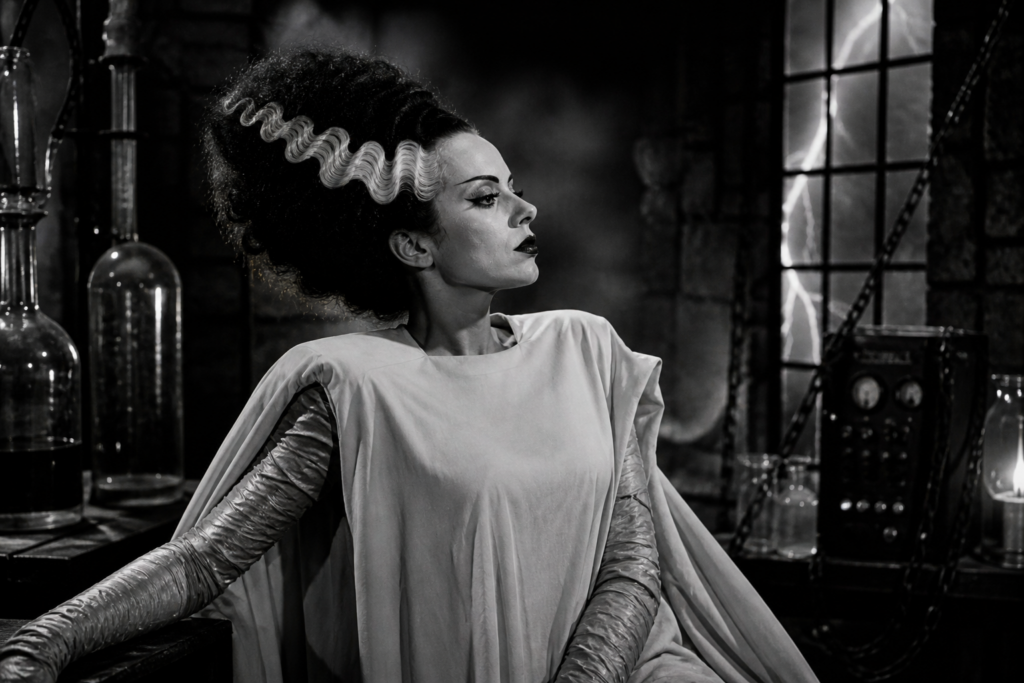
The laboratory climax is still one of the great scenes in monster cinema. The Bride’s creation feels ritualistic, almost religious. Electricity, machinery, bandaged flesh, stormlight, and madness all collide. Then Elsa Lanchester appears as the Bride, and the film becomes immortal. She is only onscreen briefly, but her impact is enormous. The tall hair with white lightning streaks, the birdlike movements, the hissing rejection of the Monster: it is unforgettable.

What makes the ending so painful is that the Monster finally gets what he asked for, and even she cannot bear him. The Bride is not a romantic reward. She is another being dragged into existence against her will. Her rejection is cruel, but it is also instinctive. She wakes into horror, sees the world that created her, and recoils. The Monster understands instantly. His dream dies in front of him.

The final line, “We belong dead,” is devastating. It is also the film’s thesis. These creations, these experiments, these broken imitations of life, cannot survive in a world built on fear and vanity. The Monster’s final act is not mindless destruction. It is judgment. He destroys the laboratory, Pretorius, and himself because the whole enterprise is rotten.

The Bride of Frankenstein

The film’s tone is one of its greatest strengths. It is genuinely eerie, but it is also funny, strange, and openly theatrical. Una O’Connor’s shrieking servant Minnie can be divisive, and some viewers may find her broad comic style too much. But even that excess belongs to the film’s odd personality. Bride of Frankenstein is not trying to be realistic. It is gothic melodrama with a wicked grin.

It also has a strong undercurrent of blasphemy, repression, social rejection, and outsider identity. Whale, who was openly gay in a time when that carried serious personal and professional risk, fills the film with coded strangeness. Pretorius, the Monster, the Bride, and even Henry all exist outside clean social order. The film is fascinated by forbidden creation, unnatural families, bodies that society rejects, and the ache of wanting companionship in a hostile world. That gives the movie a charge that still feels alive.

As a sequel, it does everything right. It respects the original but refuses to repeat it mechanically. It expands the Monster. It deepens the themes. It introduces a villain who is more intellectually dangerous than physically threatening. It gives the audience one of cinema’s most iconic female monsters, even though she appears for only a few minutes. It takes a familiar story and turns it into something more poetic and more perverse.

Nearly ninety years later, The Bride of Frankenstein still feels sharp. Some performances are deliberately heightened. Some comic beats are very much of their era. But the film’s emotional core has not aged. The Monster’s need for love, the horror of being created and abandoned, the arrogance of men who treat life as a toy, and the pain of rejection remain brutally clear.

The Bride of Frankenstein is not just one of the best Universal monster films. It is one of the best horror films ever made. It is elegant, macabre, funny, tragic, and visually magnificent. It understands that the greatest monster stories are rarely about monsters. They are about the people who make them, fear them, exploit them, and refuse to love them.

A masterpiece.

Elizabeth Báthory (1560–1614): Power, Violence, and the Making of a Legend

By History

The Blood Countess

Elizabeth Báthory was born on 7 August 1560 into the Báthory family, one of the most entrenched and politically connected dynasties in the Kingdom of Hungary. Her lineage placed her in direct proximity to power. Relatives held positions as princes of Transylvania, voivodes, and senior advisors aligned with Habsburg authority. This mattered. In late 16th-century Hungary, status determined not just wealth but legal protection, influence over land, and control over people.

Her upbringing reflected that rank. She was educated at a level uncommon even among noblewomen. Surviving evidence shows she could read and write in Hungarian, Latin, and German. She understood estate management, correspondence, and legal matters. These skills were not ornamental. They were tools she would use to run large holdings while her husband was absent.

At around 10 or 11, she was formally betrothed to Ferenc Nádasdy. The marriage took place in 1575 when she was 15. Nádasdy came from another powerful family and built a reputation as a military commander during the Long Turkish War. He spent much of his life campaigning against Ottoman forces, earning the nickname “The Black Knight of Hungary.” While he fought, Báthory remained at their estates, particularly Csejte Castle in present-day Slovakia, overseeing day-to-day operations.

This is where her real authority took shape. She managed finances, handled disputes among tenants, supervised staff, and maintained the household. Letters from the period show her making decisions on legal and economic matters. In a system where nobles had near-total control over their lands, this authority extended to discipline. Punishments for servants could be harsh and were rarely questioned by outsiders.

She gave birth to several children and maintained her role as a functioning noble matriarch. For years, there is little in the record to suggest anything out of the ordinary beyond the accepted brutality of feudal life. That begins to shift after Nádasdy’s death in 1604.

With her husband gone, Báthory became a wealthy widow controlling extensive estates. This changed her position politically. Widows could wield significant autonomy, but they also lost a layer of protection. Around this time, complaints about her treatment of servants began to circulate more openly. These were not formal charges at first. They were reports, rumors, and local grievances that built over time.

Accounts gathered later describe escalating violence. Young servant girls, often from poor rural families, were sent to her household for work and training. Testimonies allege that many were subjected to extreme physical punishment. Witnesses spoke of beatings with rods, burning, cutting, and prolonged confinement. Some described victims being left outside in freezing conditions or deprived of food. The details are graphic, but they come from depositions taken years after the alleged events, often under pressure or torture, which complicates their reliability.

What stands out is the consistency of certain claims across multiple statements. Servants described a pattern of abuse that went beyond discipline and into sustained cruelty. There are also references to accomplices within the household who carried out or assisted in these acts. Names like Dorottya Szentes (often called Dorka), Ilona Jó, and János Fickó appear repeatedly in the records as close aides involved in the violence.

The situation escalated when reports suggested that not only peasant girls but also daughters of lower-ranking noble families had been targeted. This shifted the issue from local concern to something that threatened the social order. When nobility became victims, the matter could no longer be ignored.

By 1610, King Matthias II authorized an official investigation. The task fell to Count György Thurzó, Palatine of Hungary and one of the most powerful men in the kingdom. Thurzó was also connected to Báthory through family ties, which made his role politically sensitive. He gathered evidence through a series of depositions. More than 300 witnesses were questioned. Most did not claim direct observation. They reported what they had heard from others. A smaller number described seeing injured girls or bodies.

In December 1610, Thurzó led a raid on Csejte Castle. Contemporary accounts claim that he found a dying girl and others showing signs of abuse. Some reports mention bodies, though details vary depending on the source. What is clear is that several of Báthory’s servants were arrested immediately.

The subsequent trials focused on these servants rather than Báthory herself. In early 1611, four individuals were prosecuted. Under torture, they confessed to participating in the abuse and killings of numerous girls, acting on Báthory’s orders. These confessions are central to the case but must be treated with caution. Torture was a standard method of extracting testimony at the time, and it often produced exaggerated or fabricated statements.

Three of the accused were executed. One, considered less culpable, was imprisoned. Their confessions, however, became the backbone of the narrative that defined Báthory’s legacy.

Báthory herself was never brought to a public trial. This decision was driven by politics as much as law. A public trial of a high-ranking noblewoman would have created a scandal that could destabilize alliances and embarrass powerful families, including those connected to the crown. Instead, a compromise was reached.

She was placed under house arrest at Csejte Castle. Reports describe her being confined to a set of rooms, with doors and windows sealed except for small openings to pass food. Whether this was as severe as later descriptions suggest is debated, but she remained isolated and under guard for the rest of her life.

Elizabeth Báthory died on 21 August 1614. She was 54 years old. Initial burial reportedly took place at Csejte, though her remains were later moved to the Báthory family crypt in Ecsed. The exact location of her body today is uncertain.

The number of victims attributed to her is one of the most contested aspects of the case. Some testimonies suggest dozens. Others push into the hundreds. A frequently cited figure of 650 comes from a single witness who claimed that a servant had kept a written record of deaths. No such document has ever been found. Modern historians tend to view the highest numbers as unreliable, while still acknowledging that serious abuse likely occurred.

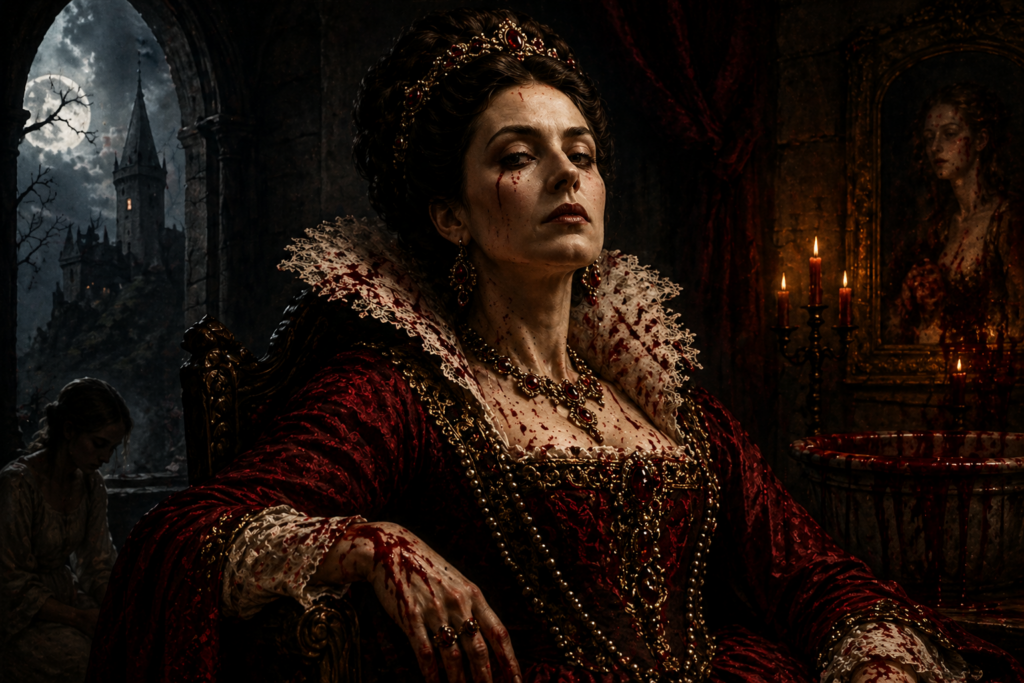
The story did not end with her death. Over the next two centuries, her case was retold and reshaped. Writers in the 18th and 19th centuries added dramatic elements that were not present in the original records. The most famous of these is the claim that she bathed in the blood of young virgins to preserve her youth. This detail has no basis in the trial documents and appears to be a later invention designed to amplify the horror of the story.

These additions transformed her from a historical figure into a mythic one. She became known as the “Blood Countess,” often linked to vampire folklore despite no direct connection in contemporary sources. The imagery stuck because it was effective. It turned a complex legal and political case into something simpler and more sensational.

Modern interpretations fall into two broad camps. One view holds that Báthory was responsible for systematic abuse and multiple killings, protected for years by her status until the scale of her actions forced intervention. The other argues that she was the target of a politically motivated conspiracy, designed to strip her of power and redistribute her lands, with testimony shaped by coercion and fear.

Both perspectives rely on the same limited set of sources. Those sources are incomplete, often secondhand, and shaped by the legal practices of the time. There is no clean, uncontested narrative.

What can be stated with confidence is this. Elizabeth Báthory lived in a system where nobles exercised near-total control over those beneath them. Violence against servants was common and rarely documented unless it crossed a threshold that threatened broader interests. She held significant power as a widow in a volatile political environment. Allegations against her were serious enough to prompt intervention at the highest level. The response avoided a public trial, suggesting that reputation and stability were prioritized over full legal exposure.

Her legacy sits between record and myth. There is credible evidence of brutality. There is also clear evidence of later embellishment. The result is a figure who continues to draw attention because the facts alone are unsettling, and the legend built on top of them is even more so.

The First Band Of Occult Rock

By Music

Before Black Sabbath ever struck their first ominous chord, before Metal even had a name, there was Coven.

Born in Chicago in the mid-1960s, Coven weren’t just another psychedelic band flirting with the occult for shock value. They were the real thing. Led by Jinx Dawson, a striking woman with aristocratic roots and a flair for the theatrical, they were the first to take Satanism out of whispered rumor and put it right there on stage, in the flesh.

“I just thought, if everyone is doing what they like – the hippie life, flowers, love, or whatever – why can’t I mix what I like into the music?” – says Dawson.

Jinx wasn’t pretending. She grew up surrounded by old books, family secrets, and stories of ritual and mysticism that most kids would never hear. While everyone else in the late sixties was preaching peace and light, she found beauty in the shadows. She didn’t see the Devil as an enemy but as a symbol of rebellion, self-acceptance, and personal power. That conviction became the heartbeat of Coven.

“I was born into a very long lineage of Occult Adepts and Practitioners of the Ancient Arts … So it was natural for me to want to mix my heritage with my music.” -continues Dawson.

Their early shows in Chicago’s underground clubs were something else entirely. No love beads, no flower crowns. The stage glowed with candlelight instead of strobes, heavy with the scent of incense and the hiss of burning wax. Dawson appeared draped in black robes, eyes like daggers, leading the band through what felt less like a concert and more like a ceremony. The audience didn’t know whether to clap or cross themselves. There were chalices, crosses turned upside down, and moments where music and ritual blurred into one unsettling spectacle.

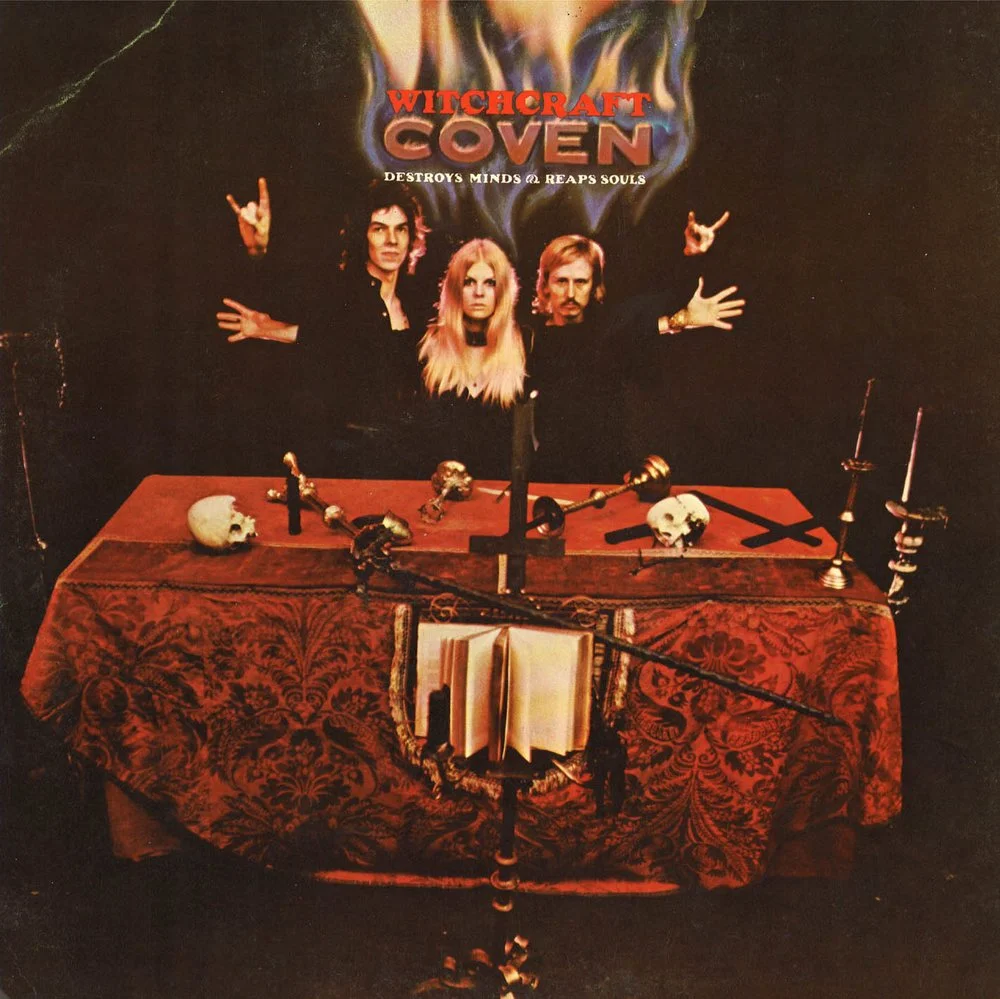
In 1969, Coven released Witchcraft Destroys Minds & Reaps Souls through Mercury Records. Even the title sounded dangerous. The songs were a wild mix of fuzz guitars, ritual chants, and lyrics that dared to say what others only hinted at. The tracklist read like a forbidden text: Black Sabbath, Pact with Lucifer, Dignitaries of Hell, Wicked Woman. And then came Satanic Mass—a thirteen-minute recording of an actual Black Mass, complete with Latin invocations and organ accompaniment. No one had ever done anything like it. This wasn’t shock rock. It was conviction pressed into vinyl.

Says Dawson, “It was actually meant to be a scholarly work; it really was not meant to be a band like the other rock bands. It was almost meant just for the stage, a sort of rock opera situation. I knew back then it was the definitive musical release on witchcraft and the occult as it was meant as a scholarly work. I am happy to see that it has held its position in occult research as many films and television shows have looked to the album for inspiration as have many bands over the years.”

On the back cover, the band threw the “sign of the horns,” a gesture that would later become synonymous with Heavy Metal. But in 1969, it was a scandal. America was already suspicious of the counterculture, and Coven looked like the smoking gun. When the Manson Family murders exploded across headlines that same summer, the country plunged into paranoia. Words like “occult” and “ritual” suddenly meant danger. Mercury Records panicked and pulled Coven’s album from shelves. Most copies were destroyed. In one brutal stroke, the band’s career was cut off before it could even start.

“Never met Manson. His unnecessary blood-party hurt our mission. The Manson murders didn’t help the situation…” says Dawson

They tried to regroup a few years later with a new approach. Their 1972 self-titled album traded darkness for light, featuring One Tin Soldier, an anti-war anthem that ended up being a surprise hit after it appeared in the film Billy Jack. Ironically, the song that made them famous was the complete opposite of everything that had made them dangerous. For some fans, it felt like betrayal. For the mainstream, it was the first time Coven seemed safe to listen to.

Coven’s self-titled second album, released in 1972 on MGM Records, marked a sharp turn from the dark rituals and Satanic symbolism that had defined their infamous debut Witchcraft Destroys Minds & Reaps Souls. After the uproar surrounding their first record and the moral panic that followed the Manson murders, the band decided to move toward a more accessible sound. The new record leaned heavily into mainstream rock and pop influences, focusing on melody rather than menace. Songs like Nightingale, Shooting Star, Dark Day in Chinatown, and I Guess It’s a Beautiful Day Today showed a more polished, radio-friendly side of the band. The standout track, One Tin Soldier (The Legend of Billy Jack), became a surprise hit after it was used in the film Billy Jack, earning Coven a level of mainstream success they had never experienced before. The album traded the ritualistic atmosphere of their debut for heartfelt songwriting and a sense of cautious optimism. Critics were mixed in their response, with some praising its strong hooks and Dawson’s voice, while others missed the fearless edge that once set them apart. Looking back, the record feels like the sound of a band trying to find its footing after being burned by controversy. It may not have carried the same occult fire, but it captured a moment when Coven tried to reconcile who they were with what the world would allow them to be.

Coven’s third album, Blood on the Snow, released in 1974 on Buddah Records, showed the band once again reinventing themselves. This time they leaned back toward a heavier rock sound, though still stripped of the full occult imagery that had once made them infamous. The album was more confident and muscular than their 1972 release, blending elements of hard rock and early glam with a sense of drama that had always been part of Coven’s identity. Songs like Night Crawler, Don’t Call Me, and the title track Blood on the Snow carried a raw energy that hinted at what the band could have become if the world had caught up to them sooner. The record is also notable for featuring one of the first promotional music videos ever made for a rock band, a bold move that predated MTV by nearly a decade. The video, created for the title track, showed the band performing amid moody visuals and theatrical lighting, capturing their flair for ritual and spectacle without relying on overt Satanic themes. Despite its creativity, Blood on the Snow didn’t make a commercial impact, and the lack of label support led the band to fade from the spotlight soon after. In hindsight, the album feels like the last gasp of an era—a record that bridged the wild experimentation of the late 1960s with the hard-edged sound that would define rock in the years to come. It stands today as an underrated but fascinating piece of Coven’s story, a glimpse of a band still burning with vision even as the world stopped watching.

Then came the eighties. Metal got darker. Bands like Venom, Mercyful Fate, and Slayer began embracing the kind of imagery Coven had pioneered years earlier. Collectors started hunting for Witchcraft Destroys Minds & Reaps Souls, passing around bootlegs and writing about this mysterious group who had recorded a Black Mass before Black Sabbath even released their debut. Slowly, the legend returned. Jinx Dawson was no longer an odd footnote—she was recognized as the first woman to drag real Satanism into rock music.

By the 2000s, Dawson reappeared, performing again after decades of silence. She was older, sure, but still every bit the High Priestess. Her presence was commanding, her voice untouched by time. Audiences at festivals like Roadburn and Sweden Rock watched in awe as she performed the same songs that had once been banned. It wasn’t nostalgia—it felt like justice.

Coven’s influence runs deep now. You can hear their shadow in the ritual theatrics of Ghost, the mystic storytelling of Blood Ceremony, the dark ceremony of The Devil’s Blood. They created the blueprint before anyone else had the courage to. The horns, the inverted cross, the invocation of the Left Hand Path—all of it started with Coven.

Black Sabbath may have defined what metal sounded like, but Coven defined what it looked and felt like. They were the spark that lit the black flame, the ones who proved that music could be both rebellion and ritual.

Jinx Dawson didn’t just front a band. She created a myth. She struck the first match, lit the first black candle, and invited the world to stare straight into the fire. It just took the rest of us fifty years to catch up.

Jinx Dawson – High Priestess of Occult Rock

Few figures in rock history are as enigmatic and influential as Jinx Dawson, the frontwoman of Coven and one of the first women in rock to openly embrace the occult. Long before theatrical Satanism became a hallmark of heavy metal, Dawson was lighting black candles on stage, flashing the horns of the Devil, and singing invocations to Lucifer with operatic flair.

Born into a wealthy Midwestern family with aristocratic roots, Dawson has often spoken of her exposure to esoteric traditions from an early age. Whether literal or symbolic, this background gave her a foundation upon which she built her artistic persona: a mixture of elegance, menace, and ritual authority. Unlike many of her contemporaries, for whom occult references were little more than countercultural window dressing, Dawson embodied the role of a High Priestess, carrying herself with theatrical seriousness and conviction.

In 1969, she became one of the most infamous women in rock with the release of Coven’s Witchcraft Destroys Minds & Reaps Souls. On the album’s back cover, she and her bandmates boldly displayed the “sign of the horns” for the first time in rock history, decades before the gesture would be immortalized by Ronnie James Dio. Onstage and on vinyl, Dawson presided over a full-length Satanic Mass, her voice weaving through ritual chants that shocked a nation already trembling from the Manson murders and moral panic.

But Dawson was more than a provocateur. She was an innovator. With her commanding stage presence, she carved out a space for female authority in the male-dominated world of heavy music, embodying a figure of occult power rather than a submissive muse. Where most women in rock were relegated to supporting roles or objectified positions, Dawson declared herself a priestess of the Left-Hand Path, commanding the stage with equal parts grace and menace.

After Coven’s fall from mainstream view in the 1970s, Dawson largely disappeared from the spotlight. Yet she remained a cult figure, whispered about among record collectors and occultists. When she returned in the 2000s and 2010s for a new wave of Coven performances, audiences were stunned to see that she still carried the aura of mystery and darkness that had defined her youth. Appearing at festivals like Roadburn, she proved that her presence remained undimmed — a timeless icon of ritual theater in music.

Today, Jinx Dawson is celebrated as the forgotten mother of metal’s occult tradition. Her influence can be seen in every band that uses ritual imagery, every singer who adopts the role of dark priest or priestess, and every stage set ablaze with candles and inverted symbols. If Black Sabbath fathered heavy metal, then Jinx Dawson and Coven gave it its soul — dark, mysterious, and forever bound to the forbidden.

Wallpurgis Night

By History

When the sun sets on April 30th, Walpurgis Night awakens, and transports you back in time to a day that still smells of wood smoke, carries the echoes of forgotten gods and and has the thrill of a world where superstition wasn’t seen as naive, but necessary…

Read More

The Satanic Panic

By History
It began with whispers. In the late 1970s, America was restless. The counterculture had faded, Watergate had bred distrust, and families were retreating behind locked doors as crime and cynicism rose. Amid that unease, stories began to circulate — stories of hidden cults, stolen children, and midnight rituals. By the early 1980s, those whispers had erupted into a nationwide moral firestorm that would come to be known as the Satanic Panic.

The spark was a book. *Michelle Remembers* — published in 1980 by psychiatrist Lawrence Pazder and his patient Michelle Smith — claimed to reveal “recovered memories” of horrific satanic rituals. It described secret ceremonies, sacrifices, and underground covens operating undetected within polite society. The book was presented as truth and devoured by a public eager for moral clarity in a confusing age. Its claims were unverified, but its imagery was unforgettable. The Devil, it seemed, had gone suburban.

The story began in 1976 when Michelle Smith, then in her twenties, began therapy with Pazder for depression and anxiety following a miscarriage. During these sessions, she reportedly began to experience disturbing “flashbacks.” Through the use of hypnosis, Pazder encouraged her to “remember” experiences from her childhood that she had allegedly repressed. Over hundreds of hours of recorded sessions, Smith described being trapped for over a year in a vast Satanic cult that performed grisly rituals involving sexual abuse, animal and infant sacrifice, and elaborate ceremonies invoking the Devil himself.

This is not a story of isolated incidents. This is a worldwide phenomenon. Satanism is an organized religion, thriving underground, recruiting the young, and destroying lives. What Michelle remembered is only the beginning.”

— Dr. Lawrence Pazder

The book presented these sessions as factual psychiatric evidence. Pazder argued that Smith’s trauma had been buried deep in her subconscious, shielded from conscious recall until therapy allowed it to surface. The concept of “repressed memory” gave the book its veneer of scientific authority. At the time, the theory was gaining popularity in certain corners of psychology, though it lacked empirical support. The idea that the mind could perfectly record trauma and later replay it like a film was psychologically appealing but scientifically unsound.

According to the book, the abuse took place in Victoria in the 1950s and involved hundreds of cult members, including influential community figures. Smith claimed that she witnessed multiple murders, saw infants dismembered, and was trapped in ritual ceremonies for months at a time. The narrative’s crescendo described a final ritual in which Satan himself appeared, only to be defeated when the Virgin Mary intervened, healing Michelle’s scars and erasing her physical injuries.

None of it was corroborated. Investigations by journalists, local police, and church officials found no evidence of any cult, no missing persons, no graves, no corroborating witnesses, and no record of unusual activity in Victoria during the time period described.

Despite that, Michelle Remembers was published as non-fiction and heavily promoted as a true account. Its religious overtones — the conflict between Satanic evil and divine salvation — resonated deeply with Christian readers, while its pseudo-scientific framing appealed to a growing fascination with psychiatry and trauma recovery. The book’s success was immediate. It became a bestseller, was translated into multiple languages, and made Pazder and Smith frequent guests on national television. They were interviewed by Barbara Walters, Oprah Winfrey, and Phil Donahue.

The book’s reach extended far beyond the publishing world. Pazder began consulting with police forces across North America, training officers to identify signs of “Satanic ritual abuse.” He lectured at conferences for social workers and law enforcement, warning that Satanic cults were deeply entrenched and operating in secrecy. His work was cited in early legal cases that would become central to the Satanic Panic, including the McMartin Preschool trial in California.

Television and newspapers amplified the fear. Daytime talk shows hosted victims of supposed cults. Evangelical preachers toured the country warning of demonic infiltration in pop culture. Heavy metal albums, Dungeons & Dragons, and horror movies were accused of recruiting youth into Satan’s ranks. Christian pamphlets mapped occult symbols in rock logos. News anchors spoke of a hidden war for the souls of children. The line between entertainment and evidence blurred completely.

Then came the McMartin Preschool case in 1983. A mother’s accusation against a daycare worker in California ballooned into the largest and most expensive trial in American history. Children, prodded by therapists, told of secret tunnels, animal sacrifices, and flights through the air. There was no physical evidence, but that hardly mattered. Dozens were accused, lives destroyed, and a template for hysteria was set.

At the same time, Anton Szandor LaVey and his Church of Satan stood as the perfect villains for the times. Founded in 1966 in San Francisco, LaVey’s church had always been more theater than theology — an atheist philosophy wrapped in gothic ritual and showmanship. His *Satanic Bible* promoted self-deification, indulgence, and rational egoism. Yet his bald head, pointed goatee, and black robes made him an irresistible symbol for those who needed a face for their fears.

LaVey’s Satan was not a horned demon but an archetype — a symbol of human freedom and rebellion. To him, ritual was a psychodrama, a way of confronting hypocrisy and guilt. But to conservative America, already primed to see Satan behind every corner, LaVey was evidence that evil had a mailing address. His image appeared in church lectures, police seminars, and tabloid exposés as proof that devil worship was not only real but organized.

He scoffed at the hysteria. “There are no Satanic conspiracies,” he told reporters. “Only human stupidity in search of a scapegoat.” But his protests couldn’t compete with the fever spreading through daytime television. Evangelists waved his photo like a wanted poster. Self-appointed “occult experts” sold VHS lectures claiming that LaVey’s followers had infiltrated schools and government. The Church of Satan — decentralized, intellectual, and small — was transformed by rumor into an underground empire.

The panic spread beyond America. In Britain, social workers claimed to uncover ritual abuse rings in Rochdale and Nottinghamshire. In Australia, police formed occult crime taskforces. Everywhere, the script repeated: terrified parents, impressionable children, no physical evidence. When investigations fell apart, authorities blamed secrecy and trauma. Faith replaced proof.

By the 1990s, the façade began to crack. Journalists and psychologists exposed the manipulation behind “recovered memories.” The McMartin case collapsed. *Michelle Remembers* was debunked. No bodies, no tunnels, no global cults. What emerged instead was a portrait of collective delusion — a moral frenzy born from religious zeal, media hunger, and the human need for order amid chaos.

Yet the deeper truth was that the panic had never really been about Satan. It was about power. It was about who defines innocence and who gets branded as evil. It was about the fragile comfort of believing that monsters exist somewhere out there, rather than within ourselves. LaVey understood that perfectly. He said that every society needs a Devil to explain its failures. Without one, people would have to face their own nature.

The panic’s embers smoldered long after the headlines faded. Its DNA can be traced straight into the digital age. In the 2010s, QAnon revived its themes almost verbatim — a secret elite abusing children, coded symbols, a call to righteous awakening. The language of “Satanic cabals” returned, dressed in hashtags instead of crosses. It no longer needed pulpits or paperback books. The internet became its new church, where rumor and faith fused once again into revelation.

The Satanic Panic taught the world how to build a moral crusade out of thin air. It showed how media can magnify belief, how authority can sanctify suspicion, and how easily justice can be drowned in hysteria. Its legacy endures every time fear replaces evidence, every time moral certainty becomes a weapon.

In the end, the Satanic Panic was not a story about the Devil. It was a story about us — about the fragile human urge to draw clean lines between good and evil, order and chaos, light and shadow. The Devil didn’t destroy America’s peace of mind. America did that all by itself, with a mirror, a microphone, and a desperate need to believe that the darkness was coming from somewhere else.

The Satanic Panic Makes a Comeback in Trump’s America

The Devil never really left America. He just learned how to log in.

Forty years later, the Satanic Panic has come back from the grave, this time wearing a red hat and a hashtag.

Today’s version doesn’t talk about daycares or black masses. It talks about “global elites,” Hollywood, Democrats, and “deep-state pedophiles.” The names have changed, the script hasn’t. QAnon — born in the chaos of Trump-era America — recycled the entire mythology. It told millions that Donald Trump was secretly fighting a cabal of Satan-worshipping child traffickers controlling the world. It sounded absurd, but it worked because it played the same emotional chords as the 1980s hysteria: fear of corruption, fear for children, fear of losing control.

In Reagan’s America, the Devil hid under the bed. In Trump’s America, he’s on Twitter.

Both panics fed on the same hunger for purity. In the 1980s, it was the Christian Right warning that Satanists were stealing the nation’s soul. Today, it’s conspiracy influencers livestreaming from basements, claiming they’ve uncovered proof of a hidden war between good and evil. The villains are no longer daycare workers — they’re Democrats, journalists, and pop stars.

The tools are different too. Back then, panic spread through talk shows and church pulpits. Now it spreads through algorithms. Facebook groups and Telegram channels have replaced prayer circles and pulpits. Social media doesn’t question, it amplifies. And the fear it breeds is faster, louder, and more weaponized.

What’s happening now isn’t nostalgia — it’s repetition. The Satanic Panic gave America a language for paranoia that never went away. It showed that people will always find comfort in a clean moral story: good versus evil, innocence versus corruption. When society fractures, that story returns like a reflex. And it’s back.

You can hear it in the calls to ban books about witchcraft. You can see it in school board meetings where parents accuse teachers of “grooming.” You can read it in the online threads where strangers swap “intel” about secret child-trafficking rings that don’t exist. The same mixture of piety, politics, and panic that drove the 1980s hysteria has simply rebranded itself for the digital age.

The truth is that America never exorcised the Satanic Panic — it just went underground until the right conditions returned. Fear, division, media, and moral certainty: the four horsemen of hysteria.

So when someone today starts whispering about “evil cabals” and “satanic agendas,” remember this: we’ve been here before. It cost innocent people their lives, their freedom, and their sanity. The Devil didn’t do that. America did.