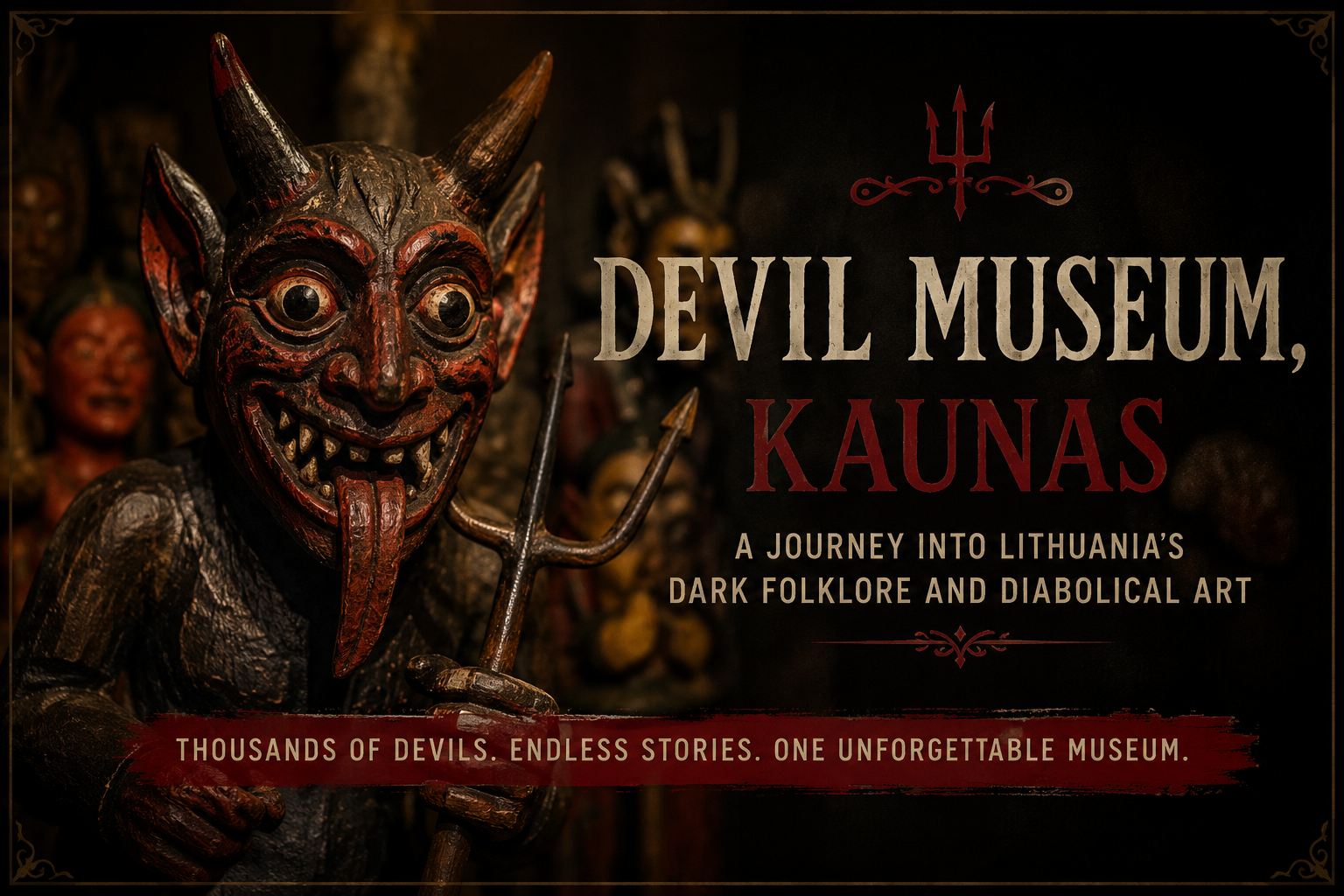
Devil Museum, Kaunas: Lithuania’s Glorious House of Horns, Folklore and Infernal Mischief
There are museums you visit because they are important. There are museums you visit because they are beautiful. Then there are museums you visit because someone says, “There is a Devil Museum in Lithuania,” and your brain immediately replies, “Say no more.”
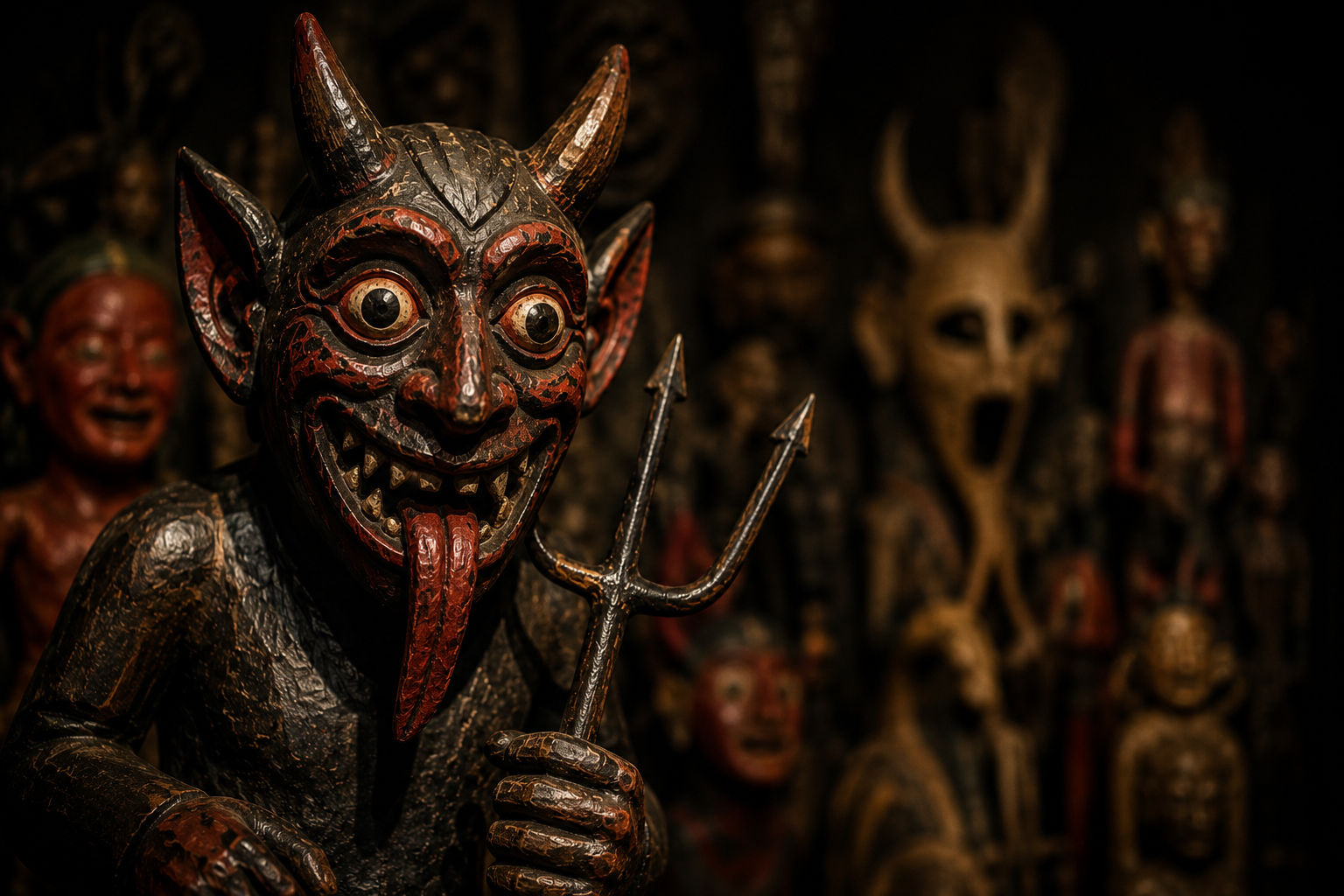
Hidden in Kaunas, Lithuania, the Devil Museum is one of those rare places that feels almost too perfect to exist. A museum devoted entirely to devils. Not one devil. Not a token demonic mask shoved into a corner cabinet. Thousands of them. Devils carved from wood, moulded from clay, painted, sculpted, worn as masks, made into souvenirs, shaped into folk art and sent in from different corners of the world.
Officially, it is known as the A. Žmuidzinavičius Creations and Collections Museum, but let us be honest. Everyone remembers the simpler name. The Devil Museum.
And what a name it is.
The museum grew from the private collection of Lithuanian artist, professor and public figure Antanas Žmuidzinavičius, who began collecting devil figures in 1906. The story goes that he was given a wooden devil sculpture during an exhibition of folk art. That one figure became the seed of something far stranger and far more enduring. Žmuidzinavičius kept collecting. What began as a personal fascination grew into a serious and wonderfully eccentric collection. After his death, the collection continued to expand, and in 1982 it was moved from the artist’s workshop into a dedicated museum space.
Today, the Devil Museum holds more than 3,000 objects. Fine art, applied art, masks, carvings, souvenirs and folk pieces all crowd together under one deliciously diabolical theme. It is one of the most unusual museums in Europe, and possibly the world.
But the real charm of the Devil Museum is not just the number of horned creatures on display. It is the way the museum reveals the devil as something far more complex than a church sermon villain.
In Lithuanian folklore, the devil is often not the grand prince of cosmic evil. He is a trickster. A fool. A drunk. A peasant. A tempter. A schemer. A ridiculous little bastard who tries to outwit people and often ends up outwitted himself. He can be frightening, but he can also be funny. Sometimes he is dangerous. Sometimes he is pathetic. Sometimes he looks suspiciously like every dodgy uncle who has ever turned up late to a family lunch smelling of spirits and bad decisions.
That is what makes this museum so fascinating. It is not really about Satan in the theological sense. It is about humanity. The devil becomes a mirror. He reflects greed, lust, stupidity, cunning, rebellion, vanity and appetite. He carries all the things polite society likes to pretend it has conquered, then laughs because he knows better.
Walk through the museum and you find devils from Lithuania, Armenia, Poland, Mexico, Japan, Cuba, Ukraine, Russia and beyond. Some are beautifully crafted. Some are crude and comic. Some are sinister. Some look like they were made by someone who feared the devil. Others look like they were made by someone who had a drink with him and found him rather good company.
This range gives the museum its pulse. The devil is not treated as one fixed idea. He changes shape depending on the culture that creates him. In one place he is a horned punisher. In another, he is a sly little rural nuisance. Elsewhere, he becomes political satire, a symbol of corruption, or a way to mock authority. The devil is endlessly useful because he can wear whatever mask a society needs him to wear.
That is the great lesson of Kaunas’ Devil Museum. The devil survives because he adapts.
The museum also has a very Lithuanian soul. Lithuania has a rich folklore tradition filled with spirits, forest creatures, household beings and supernatural troublemakers. In that world, the devil often belongs less to Hell than to the village road, the tavern, the field, the swamp or the edge of the woods. He turns up where people work, drink, argue, bargain and sin in wonderfully ordinary ways.
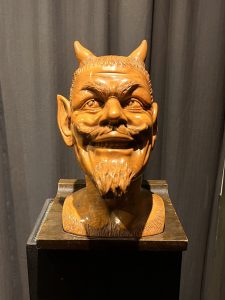 This gives the Lithuanian devil a very earthy quality. He is not always majestic. He is often local. He might be found sitting near a mill, hiding in a tree, tricking a farmer, tempting a drunkard or striking a bargain that goes wrong. He belongs to folk memory more than cathedral doctrine.
That distinction matters. In Western religious art, the devil is usually there to terrify or instruct. He is the warning at the edge of the moral map. In folk culture, he has more personality. He has habits. He has weaknesses. He can be beaten, fooled, mocked and humiliated. He is dangerous, yes, but he is also familiar.
This is why so many of the museum’s devils feel alive. They are not just decorative objects. They carry stories. Some grin like gamblers. Some sulk like defeated bureaucrats. Some leer. Some dance. Some look like they have just been caught doing exactly what everyone suspected they were doing.
There is humour everywhere, and that humour is important. The devil is at his best when he is allowed to be funny. Fear alone makes him flat. Humour gives him claws.
The Devil Museum also reminds us that diabolical imagery has always been one of the great languages of dissent. The devil is the figure you reach for when you want to mock power, expose hypocrisy, or give polite society a good slap across the face. He has been used to condemn tyrants, ridicule priests, parody politicians and embody the forbidden thoughts people are not supposed to admit they have.
In that sense, the Devil Museum is not just a cabinet of curiosities. It is a museum of cultural rebellion. Some pieces are playful, some are devotional in a folk sense, some are comic, and some are politically loaded. The devil becomes a tool for saying the quiet part out loud.
That is where the museum becomes especially interesting for anyone drawn to occult culture, Satanic history, dark art or the psychology of taboo. You do not have to believe in the devil to understand his power. In fact, belief may be the least interesting part of it. The devil matters because people keep needing him. They need him to explain fear. They need him to personify temptation. They need him to laugh at authority. They need him to carry their anxieties, their appetites and their anger.
The devil is useful because he is honest about the things humans try to hide.
Kaunas itself adds another layer to the experience. Lithuania’s second-largest city has a strong cultural identity, with museums, interwar architecture, old streets, churches, galleries and a quietly serious artistic atmosphere. Dropping a Devil Museum into that setting feels perfect. It is strange, but not gimmicky. Odd, but not cheap. It sits within a broader national museum structure and carries the weight of a genuine collection, not a roadside attraction thrown together for shock value.
That is probably the most important thing to understand before visiting. The Devil Museum is weird, but it is not trashy. It is funny, but it is not a joke. It is packed with oddities, but the collection has real cultural value. It sits at the crossroads of art, folklore, religion, superstition, satire and national identity.
For lovers of dark culture, it is a gem. For students of folklore, it is a feast. For anyone interested in how societies imagine evil, mischief and temptation, it offers more than enough to chew on.
The museum’s origin story also gives it a personal quality. This was not built from an institutional brief. It began with one man’s strange and stubborn fascination. Žmuidzinavičius planned, collected, preserved and created a foundation that kept growing long after him. There is something deeply satisfying about that. One wooden devil in 1906 becomes thousands of infernal figures more than a century later.
That is how good obsessions work. They survive the person who started them.
The collection’s expansion also says something about public affection for the place. People have continued donating objects, bringing in devils from different countries, adding to the strange congregation. The museum became a magnet for horned things. Every new object adds another accent, another joke, another warning, another cultural fingerprint.
The result is not a clean, minimalist museum experience. It is dense, eccentric and character-filled. You go there to look closely. You study faces, materials, expressions, labels and details. A quick glance will miss the point. The joy is in noticing how wildly different each devil can be. One is a beast. One is a clown. One is a craftsman’s joke. One is political rage in carved form. One is just a tiny little menace who looks far too pleased with himself.
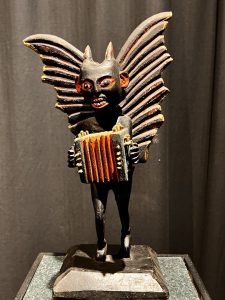 If you are visiting Kaunas, the Devil Museum deserves a place on the list. It is not the kind of attraction you can find anywhere else, and it gives you something more memorable than another polite room of landscapes and portraits. It gives you devils with personality. Devils with regional accents. Devils with bad manners and better stories.
You will not walk out converted to anything. That is not the point. You will walk out reminded that the devil is one of the most enduring characters humans have ever invented. He changes names, costumes and countries, but he never disappears. He is too useful. Too funny. Too sharp. Too close to the truth.
For Hellfire Coven readers, the Devil Museum is especially appealing because it treats the diabolical with the right balance of curiosity, humour and cultural intelligence. It does not need cheap horror theatrics. It does not need plastic cobwebs. It does not need to scream. The objects do the work. The folklore does the work. The grin on a carved wooden devil’s face does the work.
And that grin is the whole thing.
The Devil Museum in Kaunas understands something many horror attractions forget. The devil is not frightening because he is alien. He is frightening because he is familiar. He knows our cravings. He knows our arrogance. He knows our stupidity. He knows our sense of humour. He knows that, given the right circumstances, most of us will make the bargain and worry about the bill later.
That is why this museum matters. It preserves the devil not as a flat symbol of evil, but as a cultural survivor. A trickster. A rebel. A fool. A mirror. A joke with teeth.
Kaunas may not be the first city people think of when they imagine a pilgrimage into the infernal, but perhaps that is part of the appeal. The Devil Museum waits there quietly, packed with thousands of horned little witnesses to the human condition.
Some museums show us what we worship.
This one shows us what we blame, fear, mock, desire and secretly understand.
And frankly, that sounds far more interesting.
Visitor Notes
The Devil Museum is located at V. Putvinskio g. 64 in Kaunas, Lithuania. It is officially part of the M. K. Čiurlionis National Museum of Art network. Anyone planning a visit should check current opening hours before going, especially during renovation periods or seasonal changes.
Allow around one hour for a casual visit, or longer if you enjoy reading labels, studying folk art and taking in the details. This is not a place to rush. The pleasure is in the faces, the craftsmanship, the absurdity and the slow realisation that every culture seems to have invented its own version of the devil.