


The Personal Art Of Shaping Perceptions
One of the biggest misconceptions about Anton LaVey is that people assume everything he talked about revolved around rituals, black candles, curses, and supernatural power. That image followed him everywhere for decades. The media loved it because it sold magazines and frightened suburban America. But buried underneath the theatrics was something much more grounded and, honestly, much more unsettling.
 LaVey believed most people could be manipulated with surprising ease.
Not through supernatural force. Through psychology.
That was the foundation of what he called “Lesser Magic.” He described it as the art of influence. Knowing how to read people. Understanding weakness, vanity, insecurity, attraction, ego, and emotional desire. It was about learning how human beings actually operate beneath the polite masks they wear in public.
And if you really look at the modern world, it is hard to argue that he was completely wrong.
Advertising works because people are emotionally manipulated. Politicians manipulate audiences constantly. Influencers build entire careers around image and emotional projection. Dating apps are built on appearance and presentation. Corporations spend billions studying human behavior to increase sales. Social media algorithms prey on outrage, insecurity, loneliness, and validation.
LaVey simply stripped the moral language away from it and spoke about manipulation openly.
That was what shocked people.
He saw Lesser Magic as a survival skill. In his eyes, society itself was one giant performance where everybody was trying to influence everybody else, whether they admitted it or not. Religion did it. Television did it. Attractive people did it. Businesses did it. Even ordinary social interaction involved subtle forms of manipulation.
The difference was that most people pretended otherwise.
LaVey had no interest in pretending.
A lot of his ideas on Lesser Magic came from observing people long before he founded the Church of Satan in 1966. He spent years around carnivals, burlesque houses, bars, clubs, and nightlife. Those environments exposed him to every side of human behavior imaginable. Lust, greed, loneliness, desperation, fantasy, insecurity, ego. He became obsessed with watching how people reacted to image, atmosphere, and temptation.
He noticed that confidence alone could completely transform how somebody was perceived. He noticed how easily crowds could be emotionally steered. He noticed how desperately people wanted fantasy injected into their lives.
That became central to his worldview.
LaVey understood something many intellectuals completely miss. Human beings are not primarily rational creatures. Most decisions are emotional first and logical second. People buy emotionally and justify intellectually afterward. You can see this everywhere once you start looking for it.
A person buys an expensive leather jacket because it makes them feel powerful. Somebody joins a religion because it gives emotional comfort and identity. Fans worship musicians because they project danger, rebellion, glamour, or freedom. None of this is purely logical.
LaVey believed the individual who understood these emotional triggers possessed enormous power.
One of his better known ideas connected to Lesser Magic was something he called the “synthesizer clock.” He argued that most people fell into a few dominant psychological categories. Some were driven by sex and physical desire. Others were ruled by emotional sentimentality. Others craved mystery, fantasy, spectacle, or wonder.
The key, according to LaVey, was identifying what motivated someone and tailoring your approach accordingly.
A person obsessed with nostalgia reacts differently than somebody drawn toward sexuality or mystery. Politicians know this. So do advertisers. So do cult leaders.
So do rock stars.
Heavy metal and shock rock owe more to Anton LaVey than many people realize. Even artists who had little connection to Satanism borrowed heavily from his understanding of atmosphere and image. Alice Cooper, Marilyn Manson, King Diamond, and countless others understood the value of spectacle. Dramatic lighting. Ritual imagery. Dangerous symbolism. Mystery. Sexual tension. Controlled controversy.
LaVey recognized early that image could become a weapon.
And he absolutely weaponized his own image.
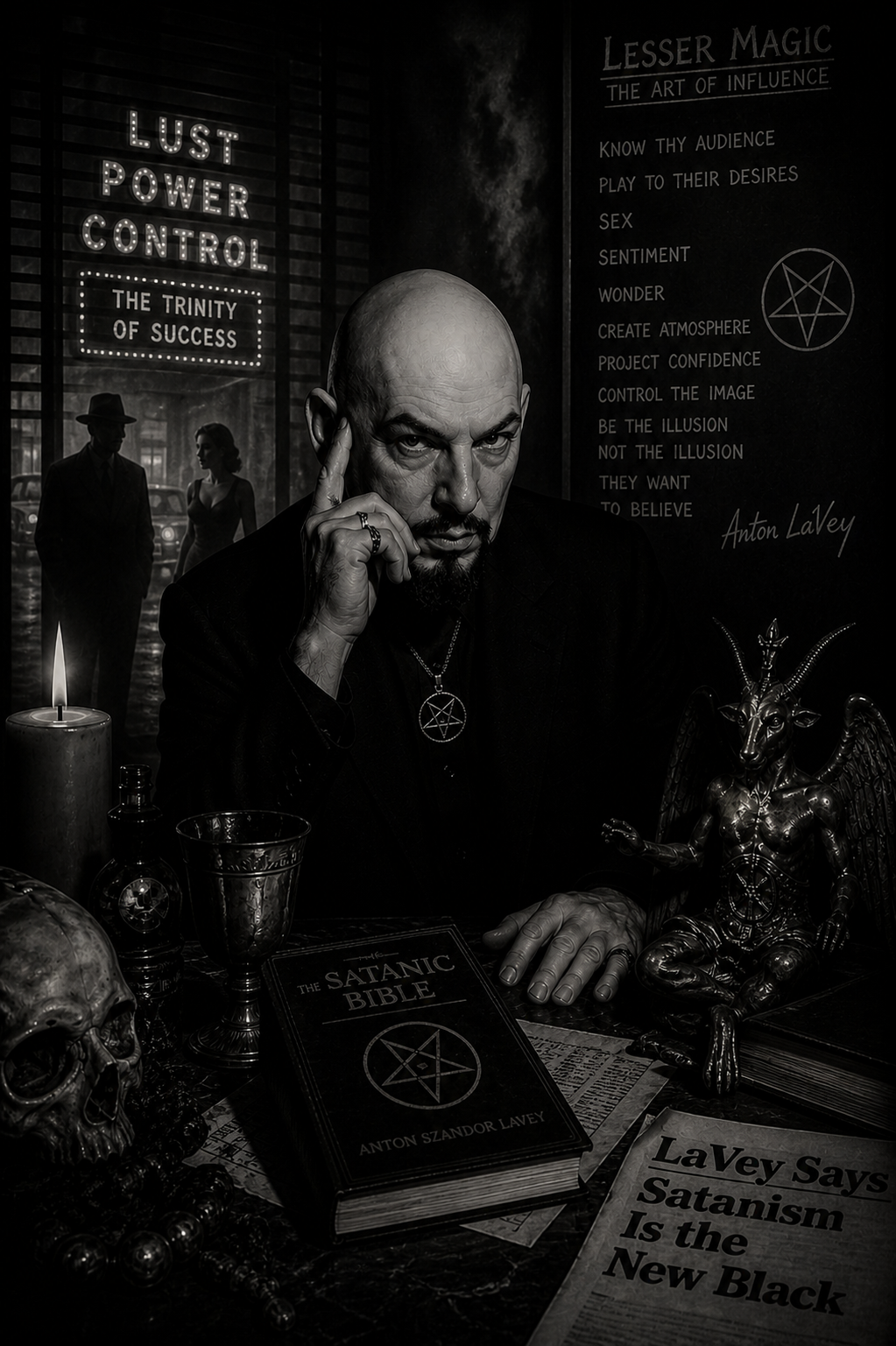
The shaved head. The black robes. The pointed beard. The organ music. The gothic rooms filled with strange objects and dark decor. The infernal symbols. None of it happened by accident. Anton LaVey understood cameras better than most celebrities. He instinctively knew what made people uncomfortable and fascinated at the same time.
The media could not get enough of him because he looked like the villain in a forbidden film.
That itself was Lesser Magic.
People often overlook how much of LaVey’s philosophy revolved around aesthetics. He believed appearance mattered enormously because human beings react instinctively before they react intellectually. Clothing changes perception. Lighting changes mood. Voice changes authority. Smell changes attraction. Atmosphere changes emotion.
Modern branding is built on these exact principles.
Walk into an Apple store and look at the lighting, spacing, sound, colors, and presentation. It is psychological theater. Luxury brands do the same thing. Nightclubs do it. Casinos do it. Influencers do it every day on Instagram and TikTok.
In some ways, social media became the ultimate evolution of Lesser Magic.
People now build carefully controlled versions of themselves online. They construct identities through photos, music taste, fashion, captions, aesthetics, and curated emotion. Mystery becomes marketable. Attractiveness becomes currency. Attention becomes power.
LaVey would have understood that world instantly.
What makes Lesser Magic uncomfortable is that it forces people to confront how artificial society often is. Most people want to believe human interaction is built on honesty and authenticity. LaVey argued that performance sits underneath almost everything.
Job interviews are performances.
Dating is performance.
Politics is performance.
Religion is performance.
Even rebellion becomes performance eventually.
That cynical worldview is part of why LaVey remains such a divisive figure. Some people see him as an insightful observer of human nature. Others see him as somebody who encouraged narcissism and emotional manipulation. There is truth on both sides.
He could be extremely perceptive, but also deeply cynical.
There is no question that Lesser Magic can slide into exploitation if taken too far. Learning how to influence people is one thing. Treating every human interaction like psychological warfare is something else entirely. Critics often accused LaVey of reducing relationships into power games and transactional exchanges. Reading some of his writing, it is not difficult to understand why.
Compassion was never really the center of his philosophy.
Strength was.
Control was.
Self-interest was.
That harshness is precisely why many people were drawn to him in the first place. LaVey emerged during a period when traditional religion still held enormous social authority. He offered an alternative built around indulgence, ego, rebellion, and personal freedom. To some followers, it felt liberating. To others, dangerous.
But whether people admired him or hated him, they paid attention to him.
And that may have been his greatest skill of all.
Anton LaVey understood attention before the modern attention economy even existed. He knew controversy created magnetism. He knew mystery attracted curiosity. He knew fear could become entertainment. He knew image could overpower substance if presented correctly.
Look around today and it almost feels prophetic.
Influencers manufacture personalities for engagement. Corporations create emotional identities around products. Politicians become brands instead of leaders. Viral outrage spreads faster than facts. Entire careers are built on aesthetics and carefully controlled perception.
Lesser Magic never really disappeared.
It just went mainstream.
That is probably the strangest part of revisiting LaVey now. Decades later, many of the techniques and observations that once made him seem shocking have become completely normalized. The world caught up to him in ways few people expected.
The candles and pentagrams were always the easy part.
The real magic was understanding people.

 The book presented these sessions as factual psychiatric evidence. Pazder argued that Smith’s trauma had been buried deep in her subconscious, shielded from conscious recall until therapy allowed it to surface. The concept of “repressed memory” gave the book its veneer of scientific authority. At the time, the theory was gaining popularity in certain corners of psychology, though it lacked empirical support. The idea that the mind could perfectly record trauma and later replay it like a film was psychologically appealing but scientifically unsound.
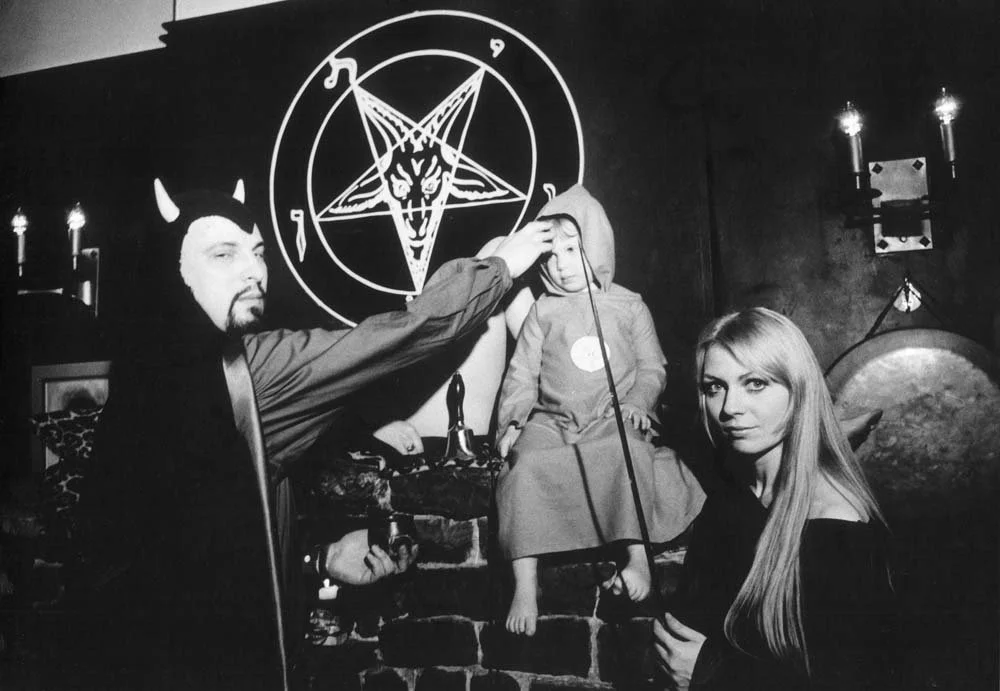 At the same time, Anton Szandor LaVey and his Church of Satan stood as the perfect villains for the times. Founded in 1966 in San Francisco, LaVey’s church had always been more theater than theology — an atheist philosophy wrapped in gothic ritual and showmanship. His *Satanic Bible* promoted self-deification, indulgence, and rational egoism. Yet his bald head, pointed goatee, and black robes made him an irresistible symbol for those who needed a face for their fears.