


The Sequel That Crawled Out Of The Shadow Of A Masterpiece
I have a strange relationship with The Exorcist III.
For years, it sat in that awkward little corner of horror history where certain films get dumped because nobody quite knows what to do with them. It wasn’t the original, obviously. Nothing is. And it sure as hell wasn’t Exorcist II: The Heretic, that bizarre fever accident of a film that still feels like somebody tried to make a religious sci-fi epic after eating bad seafood. The Exorcist III was the other one. The George C. Scott one. The hospital corridor one. The one horror fans whispered about like it was some half-buried secret.

But the more I return to it, the more I think it may be one of the most genuinely haunted horror sequels ever made.
Not haunted in the cheap sense. Not in the creaky-door, loud-noise, ghost-in-the-corner sense. Haunted by grief. Haunted by faith. Haunted by the original film. Haunted by the idea that Father Karras’ sacrifice at the end of The Exorcist may not have been the clean victory we all wanted it to be.
And that, to me, is where The Exorcist III gets under the skin.
The original Exorcist is one of the great horror films because it feels like evil has broken into an ordinary room. A mother. A child. A house. A priest losing his faith. Another priest old enough to know exactly what he is facing. It is intimate, ugly, terrifying, and completely serious about the battle it is showing us. William Friedkin directed it like a man trying to make a documentary about Hell.
The Exorcist III cannot recreate that. It would be foolish to even try. The first film had already kicked open the door. The shock of it, the cultural weight of it, the sheer violation of that little girl’s bedroom, all of that belonged to 1973. You cannot just wheel it out again, sprinkle in some pea soup, and expect lightning to hit the same crucifix twice.
William Peter Blatty seemed to understand that.
So instead of giving us a retread, he gives us something stranger. Older. More bitter. A film about what remains after the screaming stops.
At its centre is Lieutenant Kinderman, now played by George C. Scott. And what a piece of casting that is. Scott does not play Kinderman as a tidy movie detective. He plays him as a man whose soul has been worn down by years of murder, bureaucracy, stupidity, grief, and the dawning suspicion that the world may be far worse than even a homicide cop is prepared to admit.
He is cranky. He is funny. He is theatrical. He talks like a man who has too many thoughts and not enough peace. He can be tender one moment and volcanic the next. Scott gives the film a huge, bruised human presence. You feel the weight of him in every scene. He does not glide through the movie. He stomps, mutters, complains, mourns, and rages his way through it.
And somehow, that is exactly what the film needs.
 Because The Exorcist III is not really about a demon jumping out from behind the curtains. It is about a man trying to understand why evil keeps repeating itself.
The murders that draw Kinderman back into the nightmare are grotesque, ritualised, and impossible. They appear to be the work of the Gemini Killer, a serial murderer who should not be able to kill anyone because he is already dead. That alone would be enough for a solid horror-thriller. But Blatty is not interested in just making a supernatural serial killer film. He is interested in punishment. In desecration. In the long afterlife of cruelty.
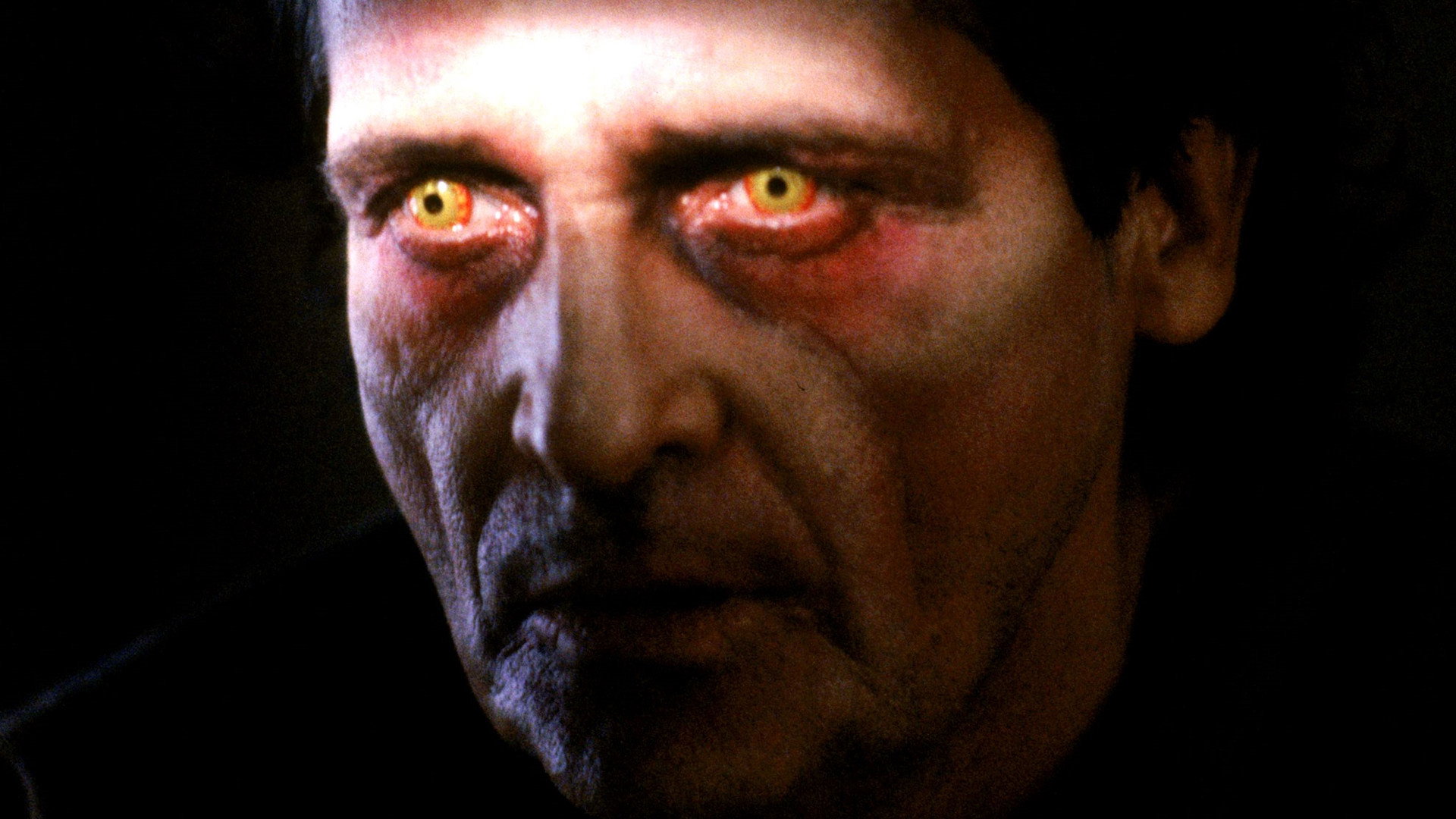
Then comes the horrible revelation: the spirit of the Gemini Killer has been placed inside the body of Father Damien Karras.
That idea is obscene.
And I mean that as praise.
Karras, the man who gave his life to save Regan in the original film, has not been allowed rest. His body has become a jail cell. His sacrifice has been mocked. Evil has taken the most sacred act in the first story and spat on it.
That is why The Exorcist III matters. It does not simply say, “The demon is back.” It says, “What if evil remembered? What if evil held a grudge? What if the victory at the end of The Exorcist was real, but not final?”
That is a much nastier idea than another spinning head.
And then you have Brad Dourif.
Good grief.
Dourif as the Gemini Killer is one of those performances that feels like it was smuggled in from a stage play being performed in a condemned asylum. He does not just chew scenery. He poisons it. He turns words into weapons. One moment he is whispering like a broken man. The next he is roaring with this awful, smug, theatrical hatred. He makes the cell scenes feel dangerous even when he is just sitting there.
The brilliance of Dourif’s performance is that he understands vanity. The Gemini Killer is not frightening because he is physically powerful. He is frightening because he wants to be admired for his evil. He wants an audience. He wants authorship. He wants his crimes to have style. That makes him pathetic, but it also makes him revolting.
There is a particular kind of evil that cannot stand being ignored. Dourif nails it.
Jason Miller’s presence hangs over the film as well, even though the production history around Karras and Patient X is messy. But emotionally, it works. Every time Karras seems to surface through the horror, you remember the ending of the original film. You remember him taking the demon into himself. You remember him throwing himself down those steps. You remember that this man already paid.
And yet here he is.
Still suffering.
That is what gives the film its ache.
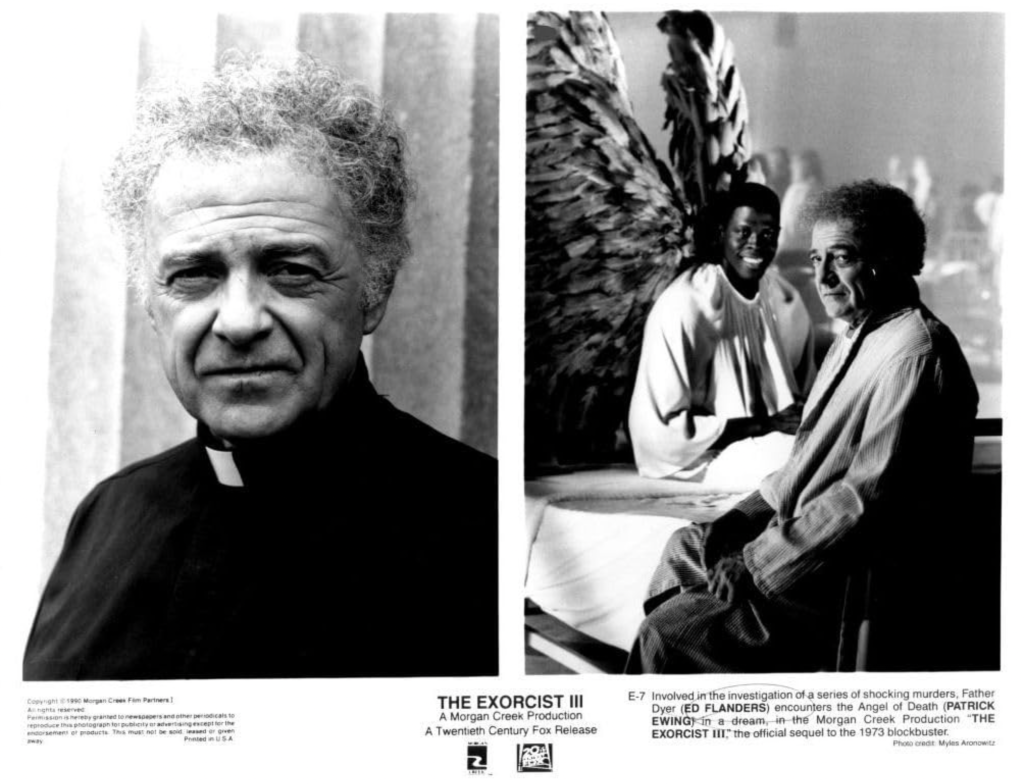
For all its reputation as a cult horror sequel, The Exorcist III is incredibly sad. It is full of old men, sick rooms, institutional corridors, religious doubt, and conversations that feel like they are happening at three in the morning when nobody has the strength to lie anymore. Even the humour has a tiredness to it. Kinderman and Father Dyer have this lovely, lived-in friendship, full of bickering and warmth. They talk about movies and food and the absurdity of existence. They feel like real old friends, not screenwriting devices.
That makes what happens later feel like a violation.
The horror in this film often comes from desecration. Bodies are desecrated. Faith is desecrated. Friendship is desecrated. Karras himself is desecrated. It is not about blood for blood’s sake. It is about the humiliation of the sacred.
That is very Blatty.
Blatty’s Catholicism was not decorative. It was not there for spooky wallpaper. His work is full of anguish over the existence of evil, but also a stubborn belief that goodness matters even when it looks ridiculous, even when it loses, even when it is exhausted. That is one of the reasons I love both The Exorcist and The Exorcist III. They do not treat evil like a cool aesthetic. Evil is not fun in these films. Evil is cruel, vain, parasitic, and childish. It breaks things because it cannot create anything worth loving.
That is a far more serious view of evil than most horror films are willing to offer.
Of course, we have to talk about the scare.
The hallway scene.
It has been praised to death, and somehow it still deserves every word. A nurse doing her rounds. A static corridor. Normal movement. Silence. Doors. Waiting. Waiting a little longer than is comfortable. Then that sudden white figure coming in with the shears.
It is a perfect jump scare because the film earns it. Blatty does not just crank the music and throw something at the lens. He lets the frame breathe until you start to relax into it. You begin watching the wrong things. You begin trusting the routine. And then the film punishes that trust.
It is beautiful, vicious filmmaking.
But I almost hate that the scene has become the film’s calling card, because The Exorcist III is so much more than one famous shock. The atmosphere around that scene is what makes it work. The hospital already feels wrong. Too clean. Too quiet. Too drained of life. The whole place feels like death has learned to use fluorescent lighting.
The film is full of that kind of dread. Not constant terror. Dread. There is a difference. Terror jumps out. Dread sits in the chair beside you and waits.
And this film waits.
That may also be why some people bounce off it. The Exorcist III is talky. Very talky. Characters do not just exchange plot points. They ramble. They argue. They philosophise. They complain about carp. They speak in long, strange, theatrical bursts that would probably be laughed out of a modern studio note session.
But I love that about it.
The talk gives the film character. It makes the people feel as though they existed before the camera arrived. Kinderman does not speak like a streamlined protagonist. Father Dyer does not speak like a stock priest. The Gemini Killer does not speak like a modern horror villain delivering trailer lines. Everyone in this movie has too much going on inside them, and sometimes it spills out in odd ways.
That is human. Messy, yes, but human.
The film itself is messy too. There is no getting around that. The studio interference is obvious. The added exorcism material at the end does not feel entirely organic. Father Morning turns up late, and you can almost hear the executives saying, “Can we please have an actual exorcist in our Exorcist movie?” The final act becomes louder and more conventional than the film wants to be.
But here is the thing: even compromised, it still works.
Not perfectly. But emotionally, it works.
Because the ending comes back to Karras. It comes back to mercy. It comes back to Kinderman, this tired, furious, decent man, having to perform one final act for his friend. That is the part that lands. Not the spectacle. Not the lightning. Not the ritual noise. The sadness.
The sadness is the soul of the film.
That is why I find The Exorcist III so much more valuable than a cleaner, safer sequel would have been. It has fingerprints all over it. Blatty’s fingerprints. Studio fingerprints. Actor fingerprints. Scars. Clashes. Strange choices. Odd humour. Big speeches. Sudden brutality. Moments of genius. Moments that wobble. It feels alive in a way many horror sequels do not.
It feels argued into existence.
And I will take that any day over a slick franchise product that knows exactly where every scare goes and has nothing rattling around inside its head.
The other thing that strikes me more and more is how much The Exorcist III feels like a bridge between eras. It has the moral seriousness of 1970s horror, the serial killer dread that would dominate parts of the 1990s, and the psychological moodiness that later horror would try to dress up as prestige. It is not fashionable. It does not feel engineered for teenagers on a Friday night. It feels like a grim little sermon delivered by a man who has had enough of easy answers.
And maybe that is why it has aged so well.
The original Exorcist will always stand alone. It is one of the monuments. You do not improve it. You do not replace it. You stand in its shadow and hope you brought something worth saying.
The Exorcist III did.
It brought grief. It brought rage. It brought Brad Dourif in a cell, tearing language apart. It brought George C. Scott barking at the darkness like he could bully Hell into explaining itself. It brought back Damien Karras, not for a cheap cameo, but as a wound reopened. It brought one of the greatest scares in horror history. It brought a strange, bruised, deeply religious sadness that no other sequel in this series has come close to matching.
For me, that is the reason the film lasts.
Not because it is flawless. It is not.
It lasts because it feels like somebody meant it.
There is conviction in it. Pain in it. A real anger at evil. A real love for the characters who have been damaged by it. And underneath all the murder, possession, police work and studio-mandated exorcism, there is a question that has been sitting there since the first film:
What does a good man do when the Devil refuses to leave the room?
In The Exorcist, Father Karras answers by sacrificing himself.
In The Exorcist III, Kinderman answers by remembering him.
That is why I keep going back to it. Not just for the scare. Not just for Dourif. Not just because it is underrated, although it is. I go back because it understands that horror is not only about the moment evil appears.
Sometimes it is about what evil leaves behind.
And The Exorcist III is absolutely covered in fingerprints.

Synopsis:
The Exorcist III: Legion follows Lieutenant Kinderman as he investigates a series of brutal murders in Georgetown that appear to mimic the work of the long-dead Gemini Killer. His search leads him to a psychiatric ward, where a mysterious patient bears a horrifying connection to Father Damien Karras, the priest who sacrificed himself at the end of The Exorcist. As Kinderman digs deeper, he discovers that evil has not vanished at all. It has simply waited, wearing a dead man’s face and turning Karras’ final act of faith into one last cruel torment. A grim, intelligent and deeply unsettling sequel, the film blends supernatural horror, serial killer dread and spiritual anguish into a story about faith, grief and the terrible things evil leaves behind.