

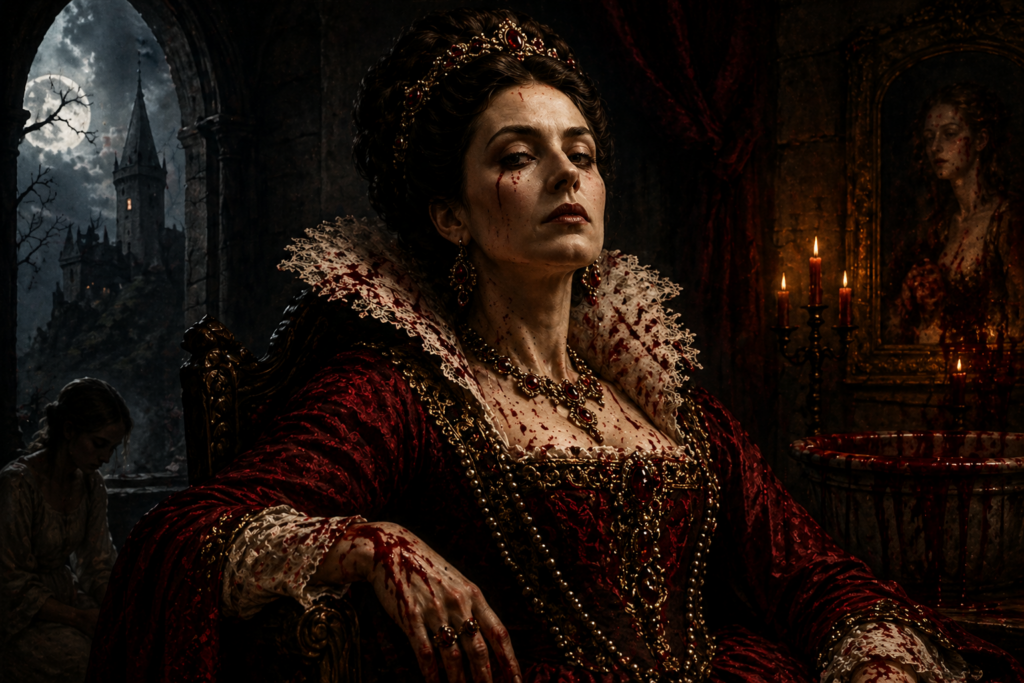
The Blood Countess
Elizabeth Báthory was born on 7 August 1560 into the Báthory family, one of the most entrenched and politically connected dynasties in the Kingdom of Hungary. Her lineage placed her in direct proximity to power. Relatives held positions as princes of Transylvania, voivodes, and senior advisors aligned with Habsburg authority. This mattered. In late 16th-century Hungary, status determined not just wealth but legal protection, influence over land, and control over people.

Her upbringing reflected that rank. She was educated at a level uncommon even among noblewomen. Surviving evidence shows she could read and write in Hungarian, Latin, and German. She understood estate management, correspondence, and legal matters. These skills were not ornamental. They were tools she would use to run large holdings while her husband was absent.
At around 10 or 11, she was formally betrothed to Ferenc Nádasdy. The marriage took place in 1575 when she was 15. Nádasdy came from another powerful family and built a reputation as a military commander during the Long Turkish War. He spent much of his life campaigning against Ottoman forces, earning the nickname “The Black Knight of Hungary.” While he fought, Báthory remained at their estates, particularly Csejte Castle in present-day Slovakia, overseeing day-to-day operations.
This is where her real authority took shape. She managed finances, handled disputes among tenants, supervised staff, and maintained the household. Letters from the period show her making decisions on legal and economic matters. In a system where nobles had near-total control over their lands, this authority extended to discipline. Punishments for servants could be harsh and were rarely questioned by outsiders.
She gave birth to several children and maintained her role as a functioning noble matriarch. For years, there is little in the record to suggest anything out of the ordinary beyond the accepted brutality of feudal life. That begins to shift after Nádasdy’s death in 1604.
With her husband gone, Báthory became a wealthy widow controlling extensive estates. This changed her position politically. Widows could wield significant autonomy, but they also lost a layer of protection. Around this time, complaints about her treatment of servants began to circulate more openly. These were not formal charges at first. They were reports, rumors, and local grievances that built over time.
Accounts gathered later describe escalating violence. Young servant girls, often from poor rural families, were sent to her household for work and training. Testimonies allege that many were subjected to extreme physical punishment. Witnesses spoke of beatings with rods, burning, cutting, and prolonged confinement. Some described victims being left outside in freezing conditions or deprived of food. The details are graphic, but they come from depositions taken years after the alleged events, often under pressure or torture, which complicates their reliability.
What stands out is the consistency of certain claims across multiple statements. Servants described a pattern of abuse that went beyond discipline and into sustained cruelty. There are also references to accomplices within the household who carried out or assisted in these acts. Names like Dorottya Szentes (often called Dorka), Ilona Jó, and János Fickó appear repeatedly in the records as close aides involved in the violence.
The situation escalated when reports suggested that not only peasant girls but also daughters of lower-ranking noble families had been targeted. This shifted the issue from local concern to something that threatened the social order. When nobility became victims, the matter could no longer be ignored.
By 1610, King Matthias II authorized an official investigation. The task fell to Count György Thurzó, Palatine of Hungary and one of the most powerful men in the kingdom. Thurzó was also connected to Báthory through family ties, which made his role politically sensitive. He gathered evidence through a series of depositions. More than 300 witnesses were questioned. Most did not claim direct observation. They reported what they had heard from others. A smaller number described seeing injured girls or bodies.
In December 1610, Thurzó led a raid on Csejte Castle. Contemporary accounts claim that he found a dying girl and others showing signs of abuse. Some reports mention bodies, though details vary depending on the source. What is clear is that several of Báthory’s servants were arrested immediately.
The subsequent trials focused on these servants rather than Báthory herself. In early 1611, four individuals were prosecuted. Under torture, they confessed to participating in the abuse and killings of numerous girls, acting on Báthory’s orders. These confessions are central to the case but must be treated with caution. Torture was a standard method of extracting testimony at the time, and it often produced exaggerated or fabricated statements.
Three of the accused were executed. One, considered less culpable, was imprisoned. Their confessions, however, became the backbone of the narrative that defined Báthory’s legacy.
Báthory herself was never brought to a public trial. This decision was driven by politics as much as law. A public trial of a high-ranking noblewoman would have created a scandal that could destabilize alliances and embarrass powerful families, including those connected to the crown. Instead, a compromise was reached.
She was placed under house arrest at Csejte Castle. Reports describe her being confined to a set of rooms, with doors and windows sealed except for small openings to pass food. Whether this was as severe as later descriptions suggest is debated, but she remained isolated and under guard for the rest of her life.
Elizabeth Báthory died on 21 August 1614. She was 54 years old. Initial burial reportedly took place at Csejte, though her remains were later moved to the Báthory family crypt in Ecsed. The exact location of her body today is uncertain.
The number of victims attributed to her is one of the most contested aspects of the case. Some testimonies suggest dozens. Others push into the hundreds. A frequently cited figure of 650 comes from a single witness who claimed that a servant had kept a written record of deaths. No such document has ever been found. Modern historians tend to view the highest numbers as unreliable, while still acknowledging that serious abuse likely occurred.
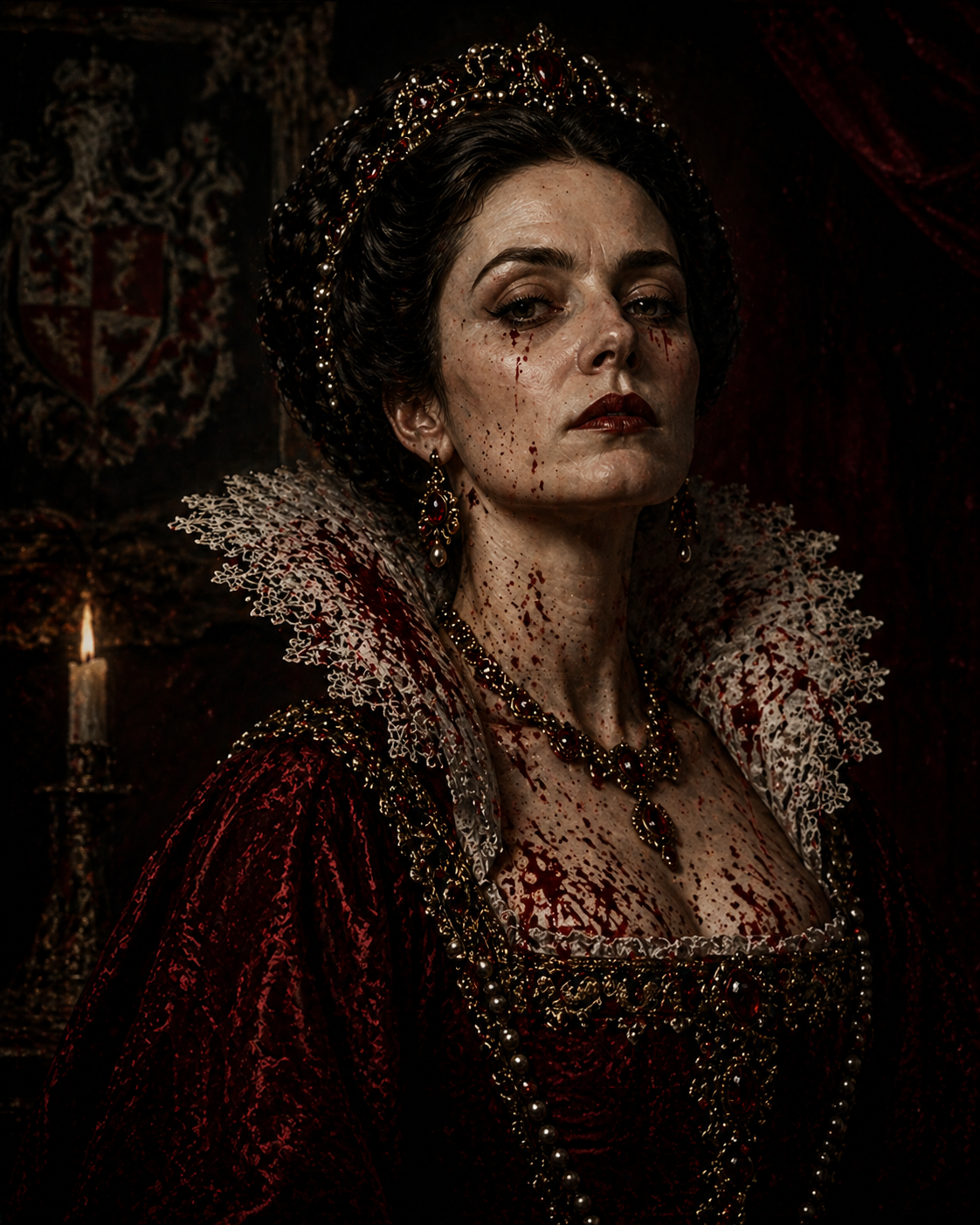
The story did not end with her death. Over the next two centuries, her case was retold and reshaped. Writers in the 18th and 19th centuries added dramatic elements that were not present in the original records. The most famous of these is the claim that she bathed in the blood of young virgins to preserve her youth. This detail has no basis in the trial documents and appears to be a later invention designed to amplify the horror of the story.
These additions transformed her from a historical figure into a mythic one. She became known as the “Blood Countess,” often linked to vampire folklore despite no direct connection in contemporary sources. The imagery stuck because it was effective. It turned a complex legal and political case into something simpler and more sensational.
Modern interpretations fall into two broad camps. One view holds that Báthory was responsible for systematic abuse and multiple killings, protected for years by her status until the scale of her actions forced intervention. The other argues that she was the target of a politically motivated conspiracy, designed to strip her of power and redistribute her lands, with testimony shaped by coercion and fear.
Both perspectives rely on the same limited set of sources. Those sources are incomplete, often secondhand, and shaped by the legal practices of the time. There is no clean, uncontested narrative.
What can be stated with confidence is this. Elizabeth Báthory lived in a system where nobles exercised near-total control over those beneath them. Violence against servants was common and rarely documented unless it crossed a threshold that threatened broader interests. She held significant power as a widow in a volatile political environment. Allegations against her were serious enough to prompt intervention at the highest level. The response avoided a public trial, suggesting that reputation and stability were prioritized over full legal exposure.
Her legacy sits between record and myth. There is credible evidence of brutality. There is also clear evidence of later embellishment. The result is a figure who continues to draw attention because the facts alone are unsettling, and the legend built on top of them is even more so.