There’s a reason this one cut through the noise. On paper it sounds like a gimmick. A possessed girl goes on a 1970s talk show and chaos unfolds live on air. In practice it plays like something much stranger. It feels like a cursed broadcast that somehow slipped through time and landed intact.

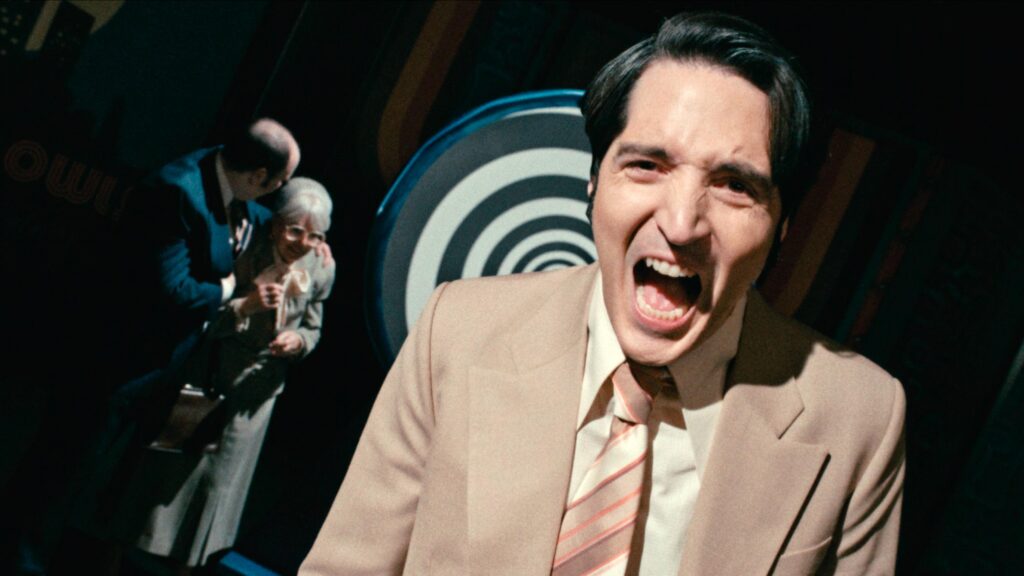
The film is set on Halloween night, 1977, during a fictional episode of Night Owls with Jack Delroy. Jack is a struggling late night host trying to claw back ratings after personal tragedy. That hook matters more than it first appears. This isn’t just about a possession. It’s about desperation, ego, and what someone is willing to invite into the room when their career is dying in front of them.
David Dastmalchian carries the whole thing. He doesn’t play Jack as a caricature. There’s a quiet sadness under the charm. You buy him as a man who has spent years smiling for the camera while something hollow grows underneath. That emotional grounding is what lets the film escalate into full-blown horror without tipping into parody.

The structure is where it really gets clever. Most of the film is presented as the “live broadcast,” complete with period-accurate cameras, clunky transitions, ad breaks, and studio audience reactions. Between segments, you get black and white behind-the-scenes footage. Those moments are crucial. They strip away the performance and show the tension building in real time. Crew members get uneasy. Guests start to feel off. Jack himself becomes harder to read. It creates this creeping sense that whatever is happening isn’t contained to the show anymore.
From a production standpoint, the attention to detail is obsessive. The Cairnes brothers leaned hard into authenticity. The set design mirrors 70s network television down to the wood paneling, lighting rigs, and slightly cheap-looking props. The cameras behave like actual broadcast cameras from the era, not modern gear pretending to be old. Even the pacing feels right. There’s that slow, almost awkward rhythm those shows used to have, which makes the later breakdown hit harder.
They also made a key decision that pays off massively. Practical effects over heavy CGI. When things start to go wrong, it feels tactile. There’s weight to it. You’re not watching polished digital horror. You’re watching something messy, immediate, and uncomfortable, like it’s happening in front of an audience that didn’t sign up for it.
Behind the scenes, the filmmakers have talked about wanting the movie to feel like a recovered tape. That idea shapes everything. The lighting is imperfect. The audio dips and distorts. The edits aren’t clean. Even the performances lean slightly heightened, like television personalities of the time. It all feeds into the illusion that this could be real.
The occult layer is where it gets interesting for you. The film doesn’t just throw in possession as a shock device. It pulls from real 1970s occult paranoia. That era was obsessed with demons, cults, and televised spirituality. Think The Exorcist, the Satanic panic building in the background, and the rise of self-help gurus mixing psychology with mysticism.
Jack himself is tied to a shadowy group called “The Grove,” which carries a very clear nod to real-world elite societies and secret rituals. It never over-explains this, which is the right call. The suggestion is enough. It frames Jack not as an innocent host who stumbled into horror, but as someone who may have brushed up against darker ideas long before the show went off the rails.
The possession narrative also plays with control and performance. The young girl, Lily, is introduced through a parapsychologist as a survivor of a satanic cult. The film never fully confirms where the truth ends and manipulation begins. Is this a genuine demonic presence, or a constructed spectacle that goes too far? That ambiguity is key. It keeps the horror grounded in psychology while still allowing the supernatural to bleed through.
Reactions have been strong for a reason. Audiences tend to fall into two camps. One group gets completely pulled into the illusion and finds it genuinely unsettling. The other admires the craft but keeps a bit of distance because of the format. Either way, almost everyone agrees Dastmalchian’s performance and the commitment to the bit are what sell it.
Where it really lands is in its final stretch. Without giving anything away, the film abandons its controlled format and lets things unravel. That shift can be divisive. Some people love the escalation. Others prefer the tighter, broadcast-driven tension of the earlier acts. But even if you don’t love the ending, it sticks. It doesn’t fade out quietly.
At its core, this isn’t just a horror film. It’s about the cost of chasing attention. Jack isn’t battling a demon in the traditional sense. He’s dealing with the consequences of needing to be seen, to be relevant, to win. The occult becomes a vehicle for that. A force that steps in when the performance stops being enough.
If you’re coming at it from an occult angle, it hits a sweet spot. It respects the aesthetic and mythology without turning into cheap shock tactics. It understands that the real tension comes from belief, suggestion, and the thin line between ritual and showmanship.
It feels like something that could have existed. And that’s what makes it linger.