The Bride of Frankenstein is one of those rare sequels that does not simply continue the original story. It sharpens it, twists it, and somehow becomes stranger, funnier, sadder, more elegant, and more emotionally dangerous than the film that came before it. Released in 1935 and directed by James Whale, it remains one of Universal Horror’s crown jewels, and arguably the finest film to come out of that entire classic monster cycle.
The first Frankenstein from 1931 gave the world Boris Karloff’s Monster as an icon: the flat head, the heavy eyelids, the bolts, the stiff walk, the wounded stare. But The Bride of Frankenstein gives him a soul. That is the crucial difference. The original film is powerful, but it is also blunt, grim, and mythic. The sequel is richer. It has wit. It has cruelty. It has beauty. It has camp theatricality sitting right beside genuine tragedy. It feels like a gothic fable told by someone who understands both horror and loneliness.
The film opens with Mary Shelley, Percy Shelley, and Lord Byron discussing the aftermath of the first story. It is a bold framing device, and a cheeky one. Rather than pretend this is a straightforward continuation, Whale reminds us that Frankenstein is already legend. Mary Shelley, played by Elsa Lanchester, becomes both creator and commentator. This is especially clever because Lanchester later appears as the Bride herself, linking the author, the imagined woman, and the failed dream of creation into one strange figure.
The story picks up after the burning windmill ending of Frankenstein. Henry Frankenstein has survived, though he insists he wants to abandon his experiments and return to ordinary married life with Elizabeth. Of course, ordinary life has no place in this universe. Enter Dr. Pretorius, played magnificently by Ernest Thesiger, one of the great ghoulish eccentrics in horror cinema. Pretorius is everything Henry fears becoming: vain, brilliant, decadent, and completely untethered from morality. He does not want to discover life for noble reasons. He wants to play god because it amuses him.
Thesiger nearly steals the film. Pretorius is sinister, but he is never dull. He glides through scenes with dry amusement, raising a glass to “a new world of gods and monsters,” one of the greatest lines in horror history. He is not a mad scientist screaming in a laboratory. He is worse. He is refined, persuasive, and delighted by blasphemy. His presence pushes the film into darker, stranger territory than the first.
But the heart of the film belongs to Karloff.
The Monster in Bride is not merely a creature to fear. He is a victim of existence itself. He did not ask to be made. He did not ask to be hated. Every time he reaches toward connection, the world answers with violence. The blind hermit sequence is the emotional centre of the film, and it still works beautifully. For a brief moment, the Monster finds shelter, warmth, music, food, and friendship. He learns words. He learns kindness. He learns that fire can comfort rather than destroy. Then, inevitably, humans arrive and ruin it.
That scene is why the film endures. The Monster’s tragedy is not that he is ugly. It is that he becomes human enough to understand rejection. Karloff plays that pain with astonishing restraint. His body language is heavy and awkward, but his face is full of longing. When he says “Alone: bad. Friend: good,” it could be ridiculous in lesser hands. Instead, it cuts right through.
Visually, the film is stunning. Whale and cinematographer John J. Mescall fill the screen with sharp shadows, towering laboratory equipment, expressionist angles, graveyards, crypts, stormy skies, and candlelit interiors. The design is pure gothic theatre, but it never feels cheap. The sets have a dreamlike quality, as though the whole film is taking place inside a nightmare staged by a lunatic with excellent taste.
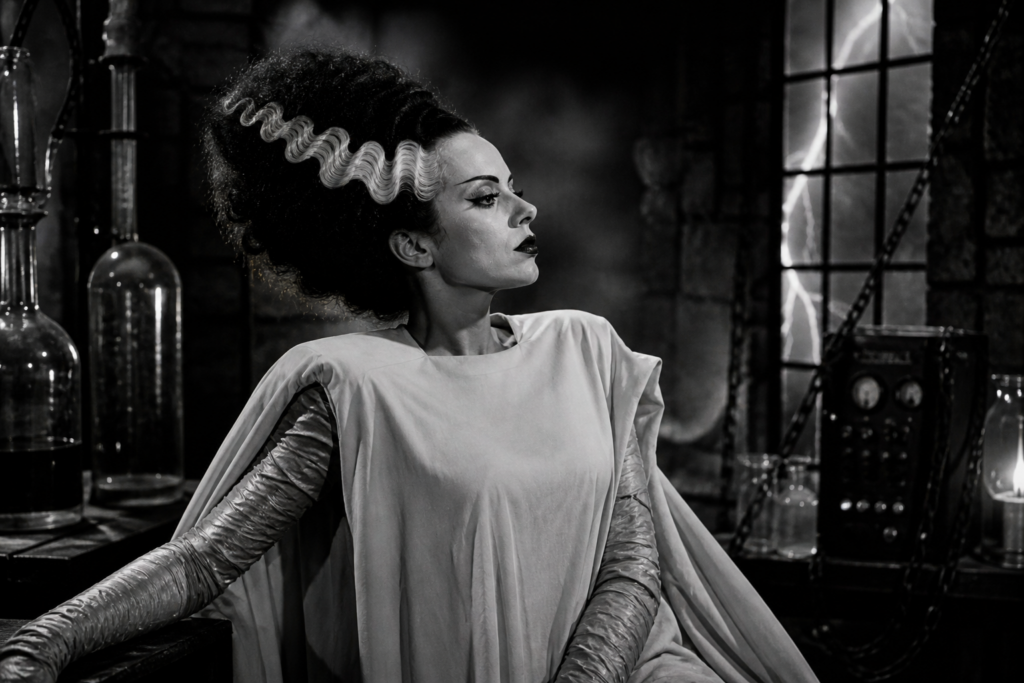
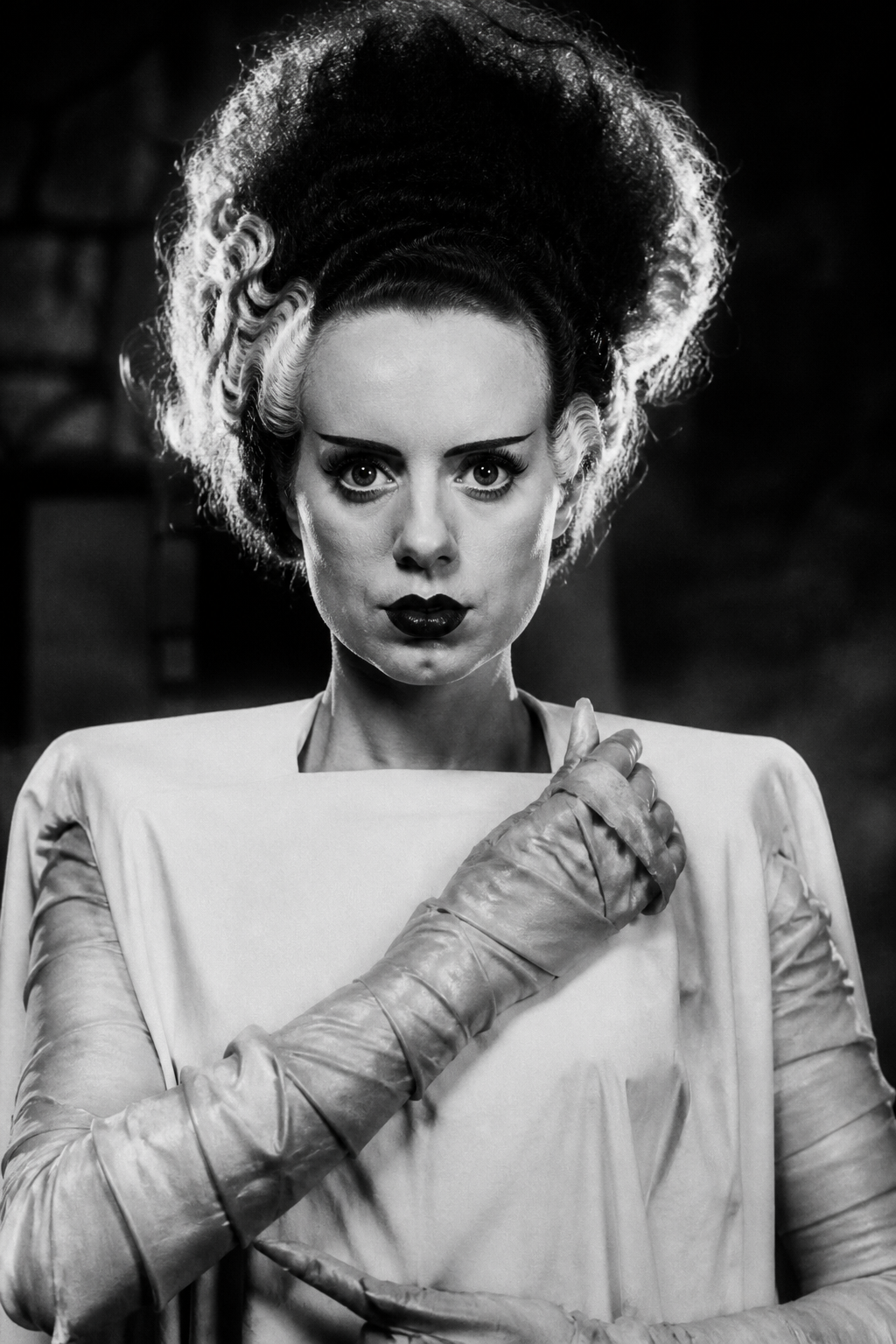
The laboratory climax is still one of the great scenes in monster cinema. The Bride’s creation feels ritualistic, almost religious. Electricity, machinery, bandaged flesh, stormlight, and madness all collide. Then Elsa Lanchester appears as the Bride, and the film becomes immortal. She is only onscreen briefly, but her impact is enormous. The tall hair with white lightning streaks, the birdlike movements, the hissing rejection of the Monster: it is unforgettable.
What makes the ending so painful is that the Monster finally gets what he asked for, and even she cannot bear him. The Bride is not a romantic reward. She is another being dragged into existence against her will. Her rejection is cruel, but it is also instinctive. She wakes into horror, sees the world that created her, and recoils. The Monster understands instantly. His dream dies in front of him.
The final line, “We belong dead,” is devastating. It is also the film’s thesis. These creations, these experiments, these broken imitations of life, cannot survive in a world built on fear and vanity. The Monster’s final act is not mindless destruction. It is judgment. He destroys the laboratory, Pretorius, and himself because the whole enterprise is rotten.
The film’s tone is one of its greatest strengths. It is genuinely eerie, but it is also funny, strange, and openly theatrical. Una O’Connor’s shrieking servant Minnie can be divisive, and some viewers may find her broad comic style too much. But even that excess belongs to the film’s odd personality. Bride of Frankenstein is not trying to be realistic. It is gothic melodrama with a wicked grin.
It also has a strong undercurrent of blasphemy, repression, social rejection, and outsider identity. Whale, who was openly gay in a time when that carried serious personal and professional risk, fills the film with coded strangeness. Pretorius, the Monster, the Bride, and even Henry all exist outside clean social order. The film is fascinated by forbidden creation, unnatural families, bodies that society rejects, and the ache of wanting companionship in a hostile world. That gives the movie a charge that still feels alive.
As a sequel, it does everything right. It respects the original but refuses to repeat it mechanically. It expands the Monster. It deepens the themes. It introduces a villain who is more intellectually dangerous than physically threatening. It gives the audience one of cinema’s most iconic female monsters, even though she appears for only a few minutes. It takes a familiar story and turns it into something more poetic and more perverse.
Nearly ninety years later, The Bride of Frankenstein still feels sharp. Some performances are deliberately heightened. Some comic beats are very much of their era. But the film’s emotional core has not aged. The Monster’s need for love, the horror of being created and abandoned, the arrogance of men who treat life as a toy, and the pain of rejection remain brutally clear.
The Bride of Frankenstein is not just one of the best Universal monster films. It is one of the best horror films ever made. It is elegant, macabre, funny, tragic, and visually magnificent. It understands that the greatest monster stories are rarely about monsters. They are about the people who make them, fear them, exploit them, and refuse to love them.
A masterpiece.