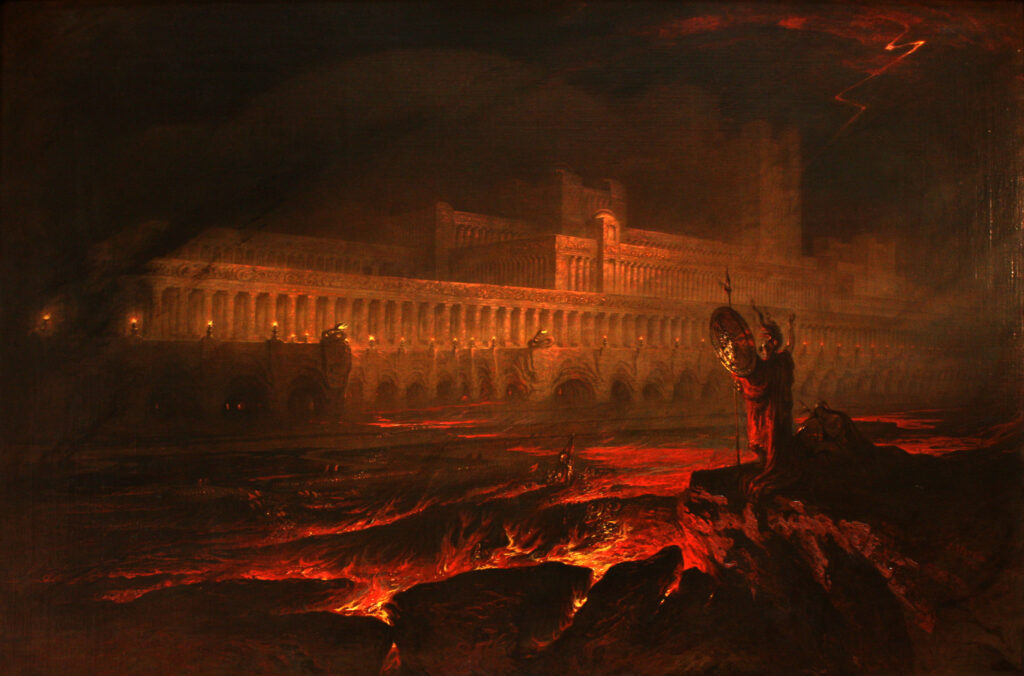
When considering the works of John Martin, one can’t help but see that he’s not an artist who paints scenes, but rather one who builds worlds, and when he turned his attention to the subjects of Satan, Hell and the apocalypse, he didn’t portray evil as a character, he engineered it as a system, an enormous, crushing structure that’s already seen the collapse of rebellion and the beginning of punishment.

Coming from the Northumberland in 1789, during the peak of the British Romanticism movement, Martin was an artist who never quite fit in with his fellow artists. While Turner blurred reality into light and movement, and Blake transformed biblical myth into visionary mysticism, Martin constructed pictures of apocalyptic annihilation that are more real than anything else. Well-known for his dark works, these feel more like plans for the end of the world than anything else.
It’s because of this that his Satan lives on.
Martin’s most famous infernal paintings originate from John Milton’s Paradise Lost, particularly his 1841 work Satan Presiding at the Infernal Council. At first glance, it may seem that Satan is the boss and sits above his defeated angels in Pandemonium, but the longer you look, the less he seems to be in control. The massive layout of his kingdom, which includes endless arched ceilings, towering columns and bottomless voids crushes every figure in the image, including Satan. Even his throne is up for grabs, perched on a structure that resembles less of a palace and more of a prison masquerading as grandeur.
Martin’s Hell is not a whirlwind of chaos, but instead has a stern and orderly system, colossal in scale and that’s what makes it truly terrifying. In a stark contrast to the way earlier artists depicted the devil as grotesque, horned monstrosities and savage tormentors, Martin stripped away any obscenity from his version of Satan and changed it into a tragic heroism, someone who’s in charge over the aftermath of a cosmic catastrophe. Looking at the work of Martin you’ll see that he’s obsessed with the size of things. And people, angels, devils, get completely lost in the grandeur of the backdrops they’re set against. Coming racing into any one of his paintings is like being dropped into the middle of an almost impossible space, hurtling over dizzying heights, bridges, staircases and bottomsless pits until you finally stumble upon the characters, if at all.
Well-known for this sort of composition, Martin’s work is philosophical in its outlook.
Martin’s idea of Satan isn’t scary because of his power, it’s because he’s condemned to live in a world that already thinks he’s wrong. The enormous spaces in his paintings mean that there isn’t any escape, they go on forever and suggest that eternity isn’t happiness, but a long, unrelenting grind.
Light plays a huge part too, Martin was a master of using jarring contrasts, scorching hot flames meet absolute blackness, cities are burning on the edge of what you can see, and molten lava slices through the darkness like a fresh wound. Your eyes are constantly being yanked between the thrill of revelation and the horror of annihilation.
This use of chiaroscuro does more than add drama to his paintings, it’s basically a way of laying out the way he sees the world, and God is practically invisible in his work, but the universe itself is always doling out moral justice, so there’s no need to chain up the devil, he’s already trapped.
Coming from a Victorian audience, Martin’s work was mesmerizing. He was at the top of his game in Britain, and his shows packed in the crowds, his apocalyptic scenes and depictions of the devil were even printed as engravings and hung in middle-class homes all over England. This wasn’t fringe art, it was mainline culture staring down the face of damnation in the age of industrialisation and colonial power.
Some critics didn’t like him, they said he went over the top, was too much show-off, too heavy-handed, too unsubtle, but in the years that followed his death, we now know they didn’t have a clue what they were talking about.
When you look at the landscape of gothic horror cinema, heavy metal album art, epic fantasies, dystopian science fiction and comic book illustrations of Hell, you’ll see the fingerprint of John Martin, a British painter who didn’t get the recognition he deserves.
Well-known as the creator of the first gothic horror art, Martin’s works set the stage for how we envision Hell. It’s not a cave anymore, it’s a city. The devil doesn’t have claws, he’s a leader who commands. And when buildings themselves become the bad guys, Martin is usually there.
Coming from someone who was deeply rooted in his faith, Martin’s paintings don’t pull back from the hard realities of the world. Salvation isn’t something he promises; it’s something that’s far off, and more of an idea than a fact. What he does show us is the price we pay.
His Satan is a character who’s understood perfectly, and got what was coming to him: total control, but with no joy, eternal life with no hope. This is why his Satan is still so popular.
Martin’s paintings are not meant to seduce, but warn. He gave Hell a form so vivid, it’s stuck in the collective imagination of humanity and has been for nearly two centuries.
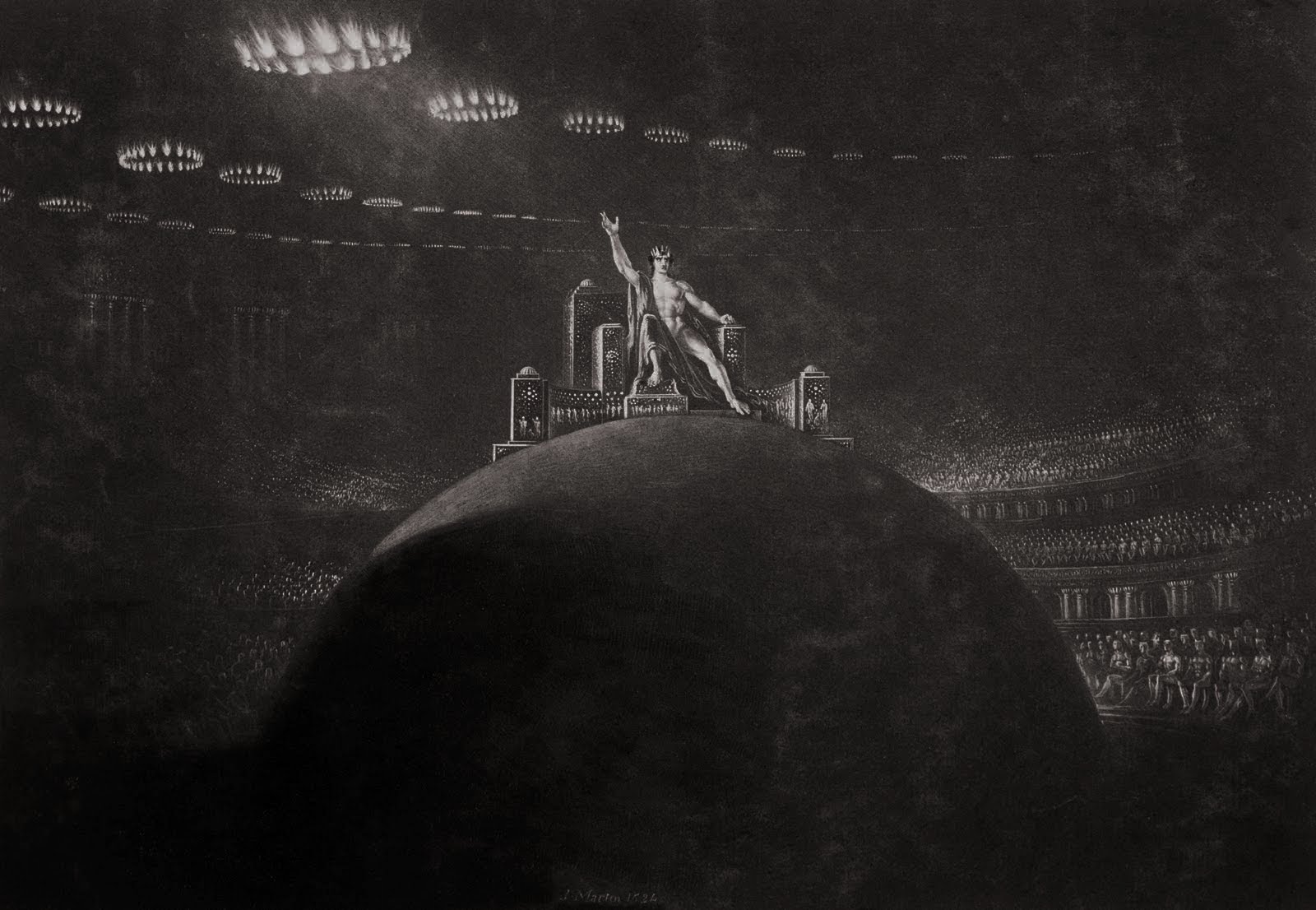
Satan Presiding, the Birth of Infernal Architecture, and the Visual Language of Metal
Looking at Martin’s Infernal Council you can’t help but think that the scene still has a very contemporary feel to it. Well-known artist and scholar, Martin, didn’t paint a picture, he basically constructed a design for a place of eternal torment.
Coming across this scene might lead you to believe that it’s a classical composition.
The devil sits on his throne, a gathering of evil spirits, and order is restored after a rebellion. But Martin quietly subverts that sense of stability all over the place.
Satan’s throne may be high up, but it’s precariously balanced and doesn’t have a solid foundation. The cavernous space surrounding him is filled with mind-boggling arches, bridges and steep drops that go way beyond the edge of the picture. The structure doesn’t radiate out from him, it swallows him whole. He isn’t the source of power here, he’s just stuck in the midst of it all.
Well-known to be a radical thinker, Martin takes a very different view of Satan, he doesn’t see him as a heroic figure, or a misunderstood rebel. Instead, he’s an absolute loser who has been crushed. What’s left is a soulless bureaucracy, and an endless administration over the condemned. Hell is no longer a battlefield, it’s a prison, a cold and uncaring institution.
If you look at the fallen angels, they’re basically faceless, they blur into a mass, their identities completely gone, their rebellion has completely eroded any sense of individuality.
The starkly symmetrical architecture and repetition of arches in the picture is meant to hammer home the idea that Hell is an endless, purposeless city, and its inhabitants are just contained. In many ways it’s got a chilling totalitarian feel to it.
Light in this picture is surgical and doesn’t warm anything up.
It’s more like a cold, heartless examination of its surroundings. The highlights are sharp and slice through the edges of stone and metal, sending everything else into the dark depths of despair. The light doesn’t come from the devil, it’s coming from the machinery of the underworld itself. When heavy metal music burst onto the scene in the 1970s and 80s it instinctively turned away from the outdated medieval images of the devil, and instead gave us something much closer to the picture that Henry Fuseli had painted. Satan as a ruler, somebody who is above the rest of us, a presence that is hard to ignore, and a part of a much bigger system. Well-known artists in the metal scene, like Iron Maiden and Dio, have run with this idea of taking the listener on a tour of epic realms, but they’re still stuck with the idea that it’s not the size of the individual that matters but the environment they’re in.
As death metal and black metal started to appear in the latter half of the 80s, the whole aesthetic of album covers became more about imposing buildings, cathedrals and crumbling ruins, cities that seem to go on forever, where people are often tiny and sometimes completely absent. This is pure Fuseli. Even when the devil shows up in metal art he’s usually sitting back on his throne, or at the top of a massive structure. He doesn’t celebrate his victories, he rules, and takes charge.
Well-known word, “presiding”, comes to mind here. It means duty, obligation, endless routine. Fuseli’s Satan is not destined to torment others but will be stuck in the mess he created, and forever feel the consequences of his rebellion. Film has picked up on this language too, from the silent movies to modern Gothic horror, hell has started to feel like a place of scale rather than entertainment. Vast halls, endless staircases, monolithic cities ablaze with fire and darkness are all coming straight from Fuseli’s engravings that were circulating through Victorian culture. It’s no coincidence that his reputation has seen a huge boost in recent years.
Today, we’re living in a world where systems are bigger than individuals, and don’t even know who we are anymore. Bureaucracies, megacities, networks, they all sound like things that are straight out of Fuseli’s hell. His devil is now less like a monster and more like someone who manages the disaster zone. That’s why his artwork is hitting such a chord with underground culture, heavy metal and occult aesthetics.
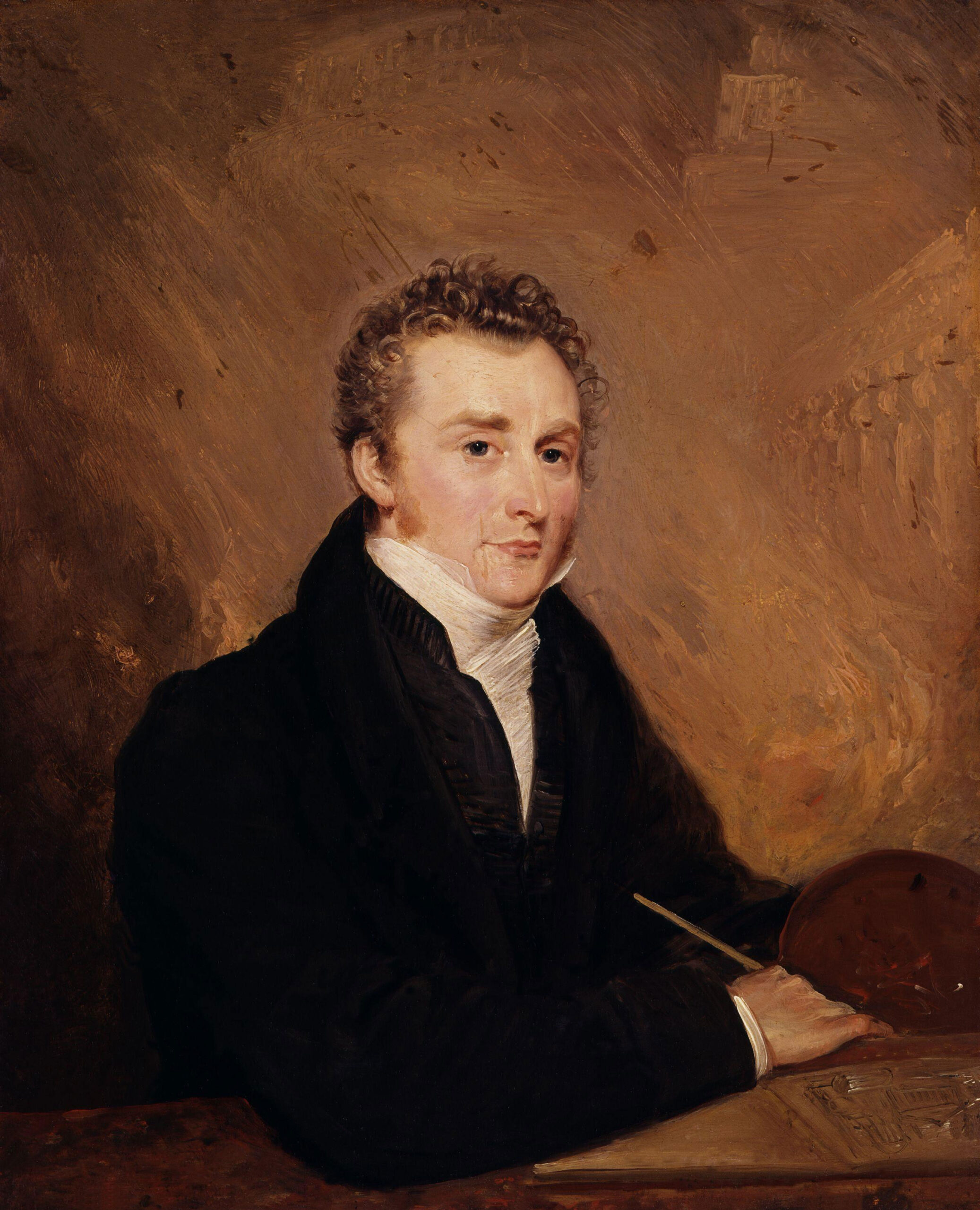
A Short History of Fire, Ruin, and Obsession
When John Martin was born in 1789 in the Northumberland town of Haydon Bridge, he was part of a massive family, being raised by a father who was a fencing master. Coming from a background marked by financial struggles, passionate religious beliefs and being right out in the wilds of northern England. Well-known as a place of awe-inspiring cliffs, ravines and dramatic skies, these landscapes would later be reimagined in Martin’s paintings into something more than life-sized and cosmic.
He moved to London as a teenager and became an apprentice coach painter, an occupation that polished his expertise in precision, architectural detail and vibrant finishes.
Something that set him apart from the rest of the fine artists of his time.
John’s introduction to the Royal Academy in the early 1810s didn’t sit well with him, and his complicated relationship with the art establishment continued to be strained. He presented to the public with regularity but the critics thought he was too ambitious, and that his paintings were just too large, too overdone and too emotional, and were basically sacrificing subtlety in favour of wow factor.
Well-known and highly publicised, Martin’s breakthrough came with Belshazzar’s Feast back in ‘21, a biblical scene that showed God sending down his wrath amidst the decadence of the royal court. People flocked to see it, the critics made fun of it, and Martin overnight became famous. This rollercoaster of response would be his pattern for the rest of his life.
Throughout the ’20s and ‘30s, Martin zeroed in on disaster, painting cataclysmic scenes on a monumental scale.
Cities collapsing, divine retribution and fire raining down from above. Paintings such as The Great Day of His Wrath and The Last Judgment sealed his reputation as the painter of the end of the world, and his unrelenting fixation on the moment when order fails and consequence kicks in.
Interestingly, Martin was not just an artist, he was also a prolific engraver. When John Martin’s mezzotint prints became widely known, they made his work accessible to a growing middle class and it was this mass reproduction that turned his haunting visions of Hell and judgment into deeply ingrained in the popular consciousness.
The pictures he made for John Milton’s Paradise Lost, were really the culmination of all he knew about the underworld. Coming heading into his later career, these images are unmistakable for their massive buildings, teeny-tiny characters, explosive contrasts between light and dark, and the feeling that there’s no escape.
Well-known as a tortured soul, Martin’s life was troubled. Financial struggles and personal tragedies marked his years, and though he was deeply religious, he started to lose faith. The death of several of his children, mental illness within his family, and his brother Jonathan’s infamous burning down of York Minster in ’29 shook him badly, and made him even more fixated on divine judgment and insanity.
By the ’40s the public’s tastes were changing. Critics started to slam him for being too flamboyant, out of touch and even disgusting, and gradually his name began to fall from the art scene. His financial situation was in shambles and he died in ‘54, basically out of fashion.
However, the verdict on Martin has been revised over time and in the 1900s, artists, filmmakers and musicians re-discovered his work, realising what the Victorian critics had missed. He was predicting the future of cinema, science fiction, dystopian art and horror movies, his enormous scales feel modern, his Hells are industrial, and his Satan looks more like a CEO than a monster, because he’s portrayed it as a system, not a being.