
It began with whispers. In the late 1970s, America was restless. The counterculture had faded, Watergate had bred distrust, and families were retreating behind locked doors as crime and cynicism rose. Amid that unease, stories began to circulate — stories of hidden cults, stolen children, and midnight rituals. By the early 1980s, those whispers had erupted into a nationwide moral firestorm that would come to be known as the Satanic Panic.
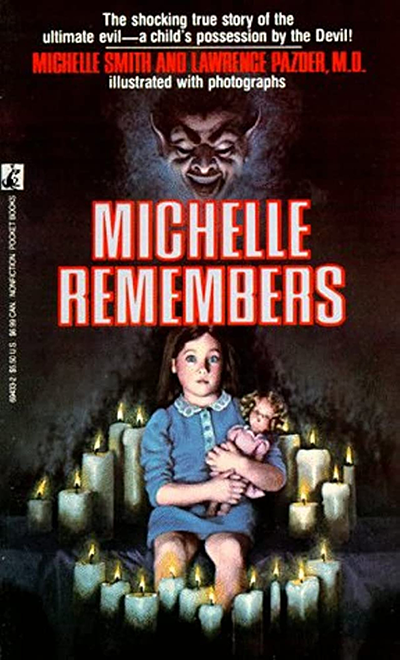
The spark was a book. *Michelle Remembers* — published in 1980 by psychiatrist Lawrence Pazder and his patient Michelle Smith — claimed to reveal “recovered memories” of horrific satanic rituals. It described secret ceremonies, sacrifices, and underground covens operating undetected within polite society. The book was presented as truth and devoured by a public eager for moral clarity in a confusing age. Its claims were unverified, but its imagery was unforgettable. The Devil, it seemed, had gone suburban.
The story began in 1976 when Michelle Smith, then in her twenties, began therapy with Pazder for depression and anxiety following a miscarriage. During these sessions, she reportedly began to experience disturbing “flashbacks.” Through the use of hypnosis, Pazder encouraged her to “remember” experiences from her childhood that she had allegedly repressed. Over hundreds of hours of recorded sessions, Smith described being trapped for over a year in a vast Satanic cult that performed grisly rituals involving sexual abuse, animal and infant sacrifice, and elaborate ceremonies invoking the Devil himself.
This is not a story of isolated incidents. This is a worldwide phenomenon. Satanism is an organized religion, thriving underground, recruiting the young, and destroying lives. What Michelle remembered is only the beginning.”
— Dr. Lawrence Pazder
 The book presented these sessions as factual psychiatric evidence. Pazder argued that Smith’s trauma had been buried deep in her subconscious, shielded from conscious recall until therapy allowed it to surface. The concept of “repressed memory” gave the book its veneer of scientific authority. At the time, the theory was gaining popularity in certain corners of psychology, though it lacked empirical support. The idea that the mind could perfectly record trauma and later replay it like a film was psychologically appealing but scientifically unsound.
According to the book, the abuse took place in Victoria in the 1950s and involved hundreds of cult members, including influential community figures. Smith claimed that she witnessed multiple murders, saw infants dismembered, and was trapped in ritual ceremonies for months at a time. The narrative’s crescendo described a final ritual in which Satan himself appeared, only to be defeated when the Virgin Mary intervened, healing Michelle’s scars and erasing her physical injuries.
None of it was corroborated. Investigations by journalists, local police, and church officials found no evidence of any cult, no missing persons, no graves, no corroborating witnesses, and no record of unusual activity in Victoria during the time period described.
Despite that, Michelle Remembers was published as non-fiction and heavily promoted as a true account. Its religious overtones — the conflict between Satanic evil and divine salvation — resonated deeply with Christian readers, while its pseudo-scientific framing appealed to a growing fascination with psychiatry and trauma recovery. The book’s success was immediate. It became a bestseller, was translated into multiple languages, and made Pazder and Smith frequent guests on national television. They were interviewed by Barbara Walters, Oprah Winfrey, and Phil Donahue.
The book’s reach extended far beyond the publishing world. Pazder began consulting with police forces across North America, training officers to identify signs of “Satanic ritual abuse.” He lectured at conferences for social workers and law enforcement, warning that Satanic cults were deeply entrenched and operating in secrecy. His work was cited in early legal cases that would become central to the Satanic Panic, including the McMartin Preschool trial in California.
Television and newspapers amplified the fear. Daytime talk shows hosted victims of supposed cults. Evangelical preachers toured the country warning of demonic infiltration in pop culture. Heavy metal albums, Dungeons & Dragons, and horror movies were accused of recruiting youth into Satan’s ranks. Christian pamphlets mapped occult symbols in rock logos. News anchors spoke of a hidden war for the souls of children. The line between entertainment and evidence blurred completely.
Then came the McMartin Preschool case in 1983. A mother’s accusation against a daycare worker in California ballooned into the largest and most expensive trial in American history. Children, prodded by therapists, told of secret tunnels, animal sacrifices, and flights through the air. There was no physical evidence, but that hardly mattered. Dozens were accused, lives destroyed, and a template for hysteria was set.
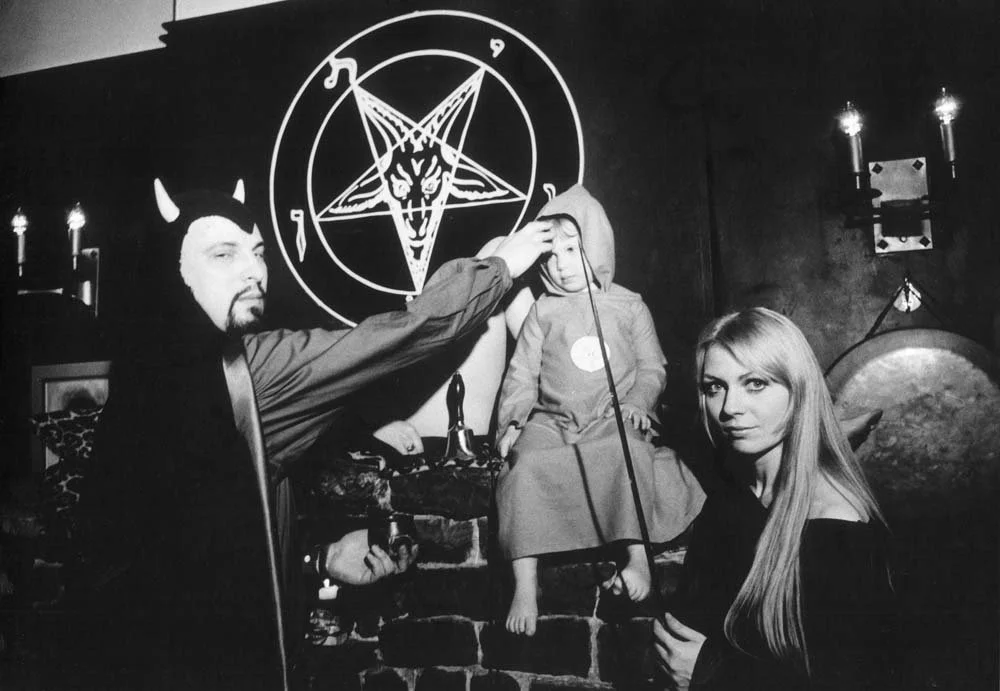 At the same time, Anton Szandor LaVey and his Church of Satan stood as the perfect villains for the times. Founded in 1966 in San Francisco, LaVey’s church had always been more theater than theology — an atheist philosophy wrapped in gothic ritual and showmanship. His *Satanic Bible* promoted self-deification, indulgence, and rational egoism. Yet his bald head, pointed goatee, and black robes made him an irresistible symbol for those who needed a face for their fears.
LaVey’s Satan was not a horned demon but an archetype — a symbol of human freedom and rebellion. To him, ritual was a psychodrama, a way of confronting hypocrisy and guilt. But to conservative America, already primed to see Satan behind every corner, LaVey was evidence that evil had a mailing address. His image appeared in church lectures, police seminars, and tabloid exposés as proof that devil worship was not only real but organized.
He scoffed at the hysteria. “There are no Satanic conspiracies,” he told reporters. “Only human stupidity in search of a scapegoat.” But his protests couldn’t compete with the fever spreading through daytime television. Evangelists waved his photo like a wanted poster. Self-appointed “occult experts” sold VHS lectures claiming that LaVey’s followers had infiltrated schools and government. The Church of Satan — decentralized, intellectual, and small — was transformed by rumor into an underground empire.
The panic spread beyond America. In Britain, social workers claimed to uncover ritual abuse rings in Rochdale and Nottinghamshire. In Australia, police formed occult crime taskforces. Everywhere, the script repeated: terrified parents, impressionable children, no physical evidence. When investigations fell apart, authorities blamed secrecy and trauma. Faith replaced proof.
By the 1990s, the façade began to crack. Journalists and psychologists exposed the manipulation behind “recovered memories.” The McMartin case collapsed. *Michelle Remembers* was debunked. No bodies, no tunnels, no global cults. What emerged instead was a portrait of collective delusion — a moral frenzy born from religious zeal, media hunger, and the human need for order amid chaos.
Yet the deeper truth was that the panic had never really been about Satan. It was about power. It was about who defines innocence and who gets branded as evil. It was about the fragile comfort of believing that monsters exist somewhere out there, rather than within ourselves. LaVey understood that perfectly. He said that every society needs a Devil to explain its failures. Without one, people would have to face their own nature.
The panic’s embers smoldered long after the headlines faded. Its DNA can be traced straight into the digital age. In the 2010s, QAnon revived its themes almost verbatim — a secret elite abusing children, coded symbols, a call to righteous awakening. The language of “Satanic cabals” returned, dressed in hashtags instead of crosses. It no longer needed pulpits or paperback books. The internet became its new church, where rumor and faith fused once again into revelation.
The Satanic Panic taught the world how to build a moral crusade out of thin air. It showed how media can magnify belief, how authority can sanctify suspicion, and how easily justice can be drowned in hysteria. Its legacy endures every time fear replaces evidence, every time moral certainty becomes a weapon.
In the end, the Satanic Panic was not a story about the Devil. It was a story about us — about the fragile human urge to draw clean lines between good and evil, order and chaos, light and shadow. The Devil didn’t destroy America’s peace of mind. America did that all by itself, with a mirror, a microphone, and a desperate need to believe that the darkness was coming from somewhere else.
The Satanic Panic Makes a Comeback in Trump’s America
The Devil never really left America. He just learned how to log in.
Forty years later, the Satanic Panic has come back from the grave, this time wearing a red hat and a hashtag.
Today’s version doesn’t talk about daycares or black masses. It talks about “global elites,” Hollywood, Democrats, and “deep-state pedophiles.” The names have changed, the script hasn’t. QAnon — born in the chaos of Trump-era America — recycled the entire mythology. It told millions that Donald Trump was secretly fighting a cabal of Satan-worshipping child traffickers controlling the world. It sounded absurd, but it worked because it played the same emotional chords as the 1980s hysteria: fear of corruption, fear for children, fear of losing control.
In Reagan’s America, the Devil hid under the bed. In Trump’s America, he’s on Twitter.
Both panics fed on the same hunger for purity. In the 1980s, it was the Christian Right warning that Satanists were stealing the nation’s soul. Today, it’s conspiracy influencers livestreaming from basements, claiming they’ve uncovered proof of a hidden war between good and evil. The villains are no longer daycare workers — they’re Democrats, journalists, and pop stars.
The tools are different too. Back then, panic spread through talk shows and church pulpits. Now it spreads through algorithms. Facebook groups and Telegram channels have replaced prayer circles and pulpits. Social media doesn’t question, it amplifies. And the fear it breeds is faster, louder, and more weaponized.
What’s happening now isn’t nostalgia — it’s repetition. The Satanic Panic gave America a language for paranoia that never went away. It showed that people will always find comfort in a clean moral story: good versus evil, innocence versus corruption. When society fractures, that story returns like a reflex. And it’s back.
You can hear it in the calls to ban books about witchcraft. You can see it in school board meetings where parents accuse teachers of “grooming.” You can read it in the online threads where strangers swap “intel” about secret child-trafficking rings that don’t exist. The same mixture of piety, politics, and panic that drove the 1980s hysteria has simply rebranded itself for the digital age.
The truth is that America never exorcised the Satanic Panic — it just went underground until the right conditions returned. Fear, division, media, and moral certainty: the four horsemen of hysteria.
So when someone today starts whispering about “evil cabals” and “satanic agendas,” remember this: we’ve been here before. It cost innocent people their lives, their freedom, and their sanity. The Devil didn’t do that. America did.